Aayush Bajaj

2026-04-29

(A)ayush (Baj)aj’s (A)ugmenting (I)nfrastructure

“We all die. The goal isn’t to live forever, the goal is to create something that will.” — Chuck Palahniuk

Originally the AI suffix stood for archived intellect, however these days it has concretised to becoming an Augmenting Infrastructure — a place from which to branch out in many directions.

Within this site you will find self-contained material in the form of project posts and blog posts, but also external links 1 to other work – my own as well as not.
Read more >

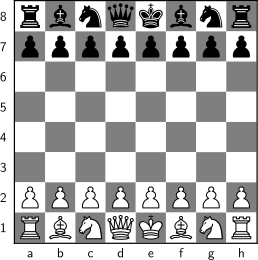
Chess

Starting position

Starting position

Read more >

Optimisation

Mathematical Background

Definition (Axiom)

A foundational statement accepted without proof. All other results are built ontop.

Definition (Proposition)

A proved statement that is less central than a theorem, but still of interest.

Definition (Lemma)

A “helper” proposition proved to assist in establishing a more important result.

Definition (Corollary)

A statement following from a theorem or proposition, requiring little to no extra proof.

Definition (Definition)

A precise specification of an object, concept or notation.

Read more >

Differential Equations

Definitions

Definition (Order)

The power the differential is raised to.

Definition (Linear)

The dependent variable and its derivatives are all not non-linear. \[\begin{aligned} \underbrace{\frac{d^2 y}{d t}} &\quad \underbrace{\cos(x) \frac{dy}{dx}} &\quad \underbrace{\frac{dy}{dt} \frac{d^3 y}{dt^3}} &\quad \underbrace{y’ = e^y} &\quad \underbrace{y \frac{dy}{dx}} \\ \text{linear} &\quad \text{linear} &\quad \text{non-linear} &\quad \text{non-linear} &\quad \text{non-linear} \end{aligned}\]

Definition (Autonomous)

Independent variable does not appear in the equation.

Definition (Non-autonomous)

Independent variable does appear in the equation.

Read more >

Kanye West RNN

About

This document contains the code to create an RNN chatbot that emulates Kanye West’s speech style.

Read more >

Version Control

notes

it is good to keep notes about version controlling things.

I mostly use git.

git

prefixuse-case
BUGbug fix
DEVdevelopment tool or utility
DOCdocumentation
ENHenhancement, a new feature
MAINTmaintainence task
RELrelease
STYstylistic change
TSTaddition or modification of tests

(A)ayush (Baj)aj’s (A)ugmenting (I)nfrastructure

“We all die. The goal isn’t to live forever, the goal is to create something that will.” — Chuck Palahniuk

Originally the AI suffix stood for archived intellect, however these days it has concretised to becoming an Augmenting Infrastructure — a place from which to branch out in many directions.

Within this site you will find self-contained material in the form of project posts and blog posts, but also external links 1 to other work – my own as well as not.

Read more >

Solutions to Leetcode

Leetcode Stats

Here lie my implementations and notes for various leetcode problems.

1. Two Sum

class Solution:
    def twoSum(self, nums: List[int], target: int) -> List[int]:
        table = dict()
        for i, num in enumerate(nums):
            if target - num in table.keys():
                return [i, table[target-num]]
            table[num] = i
        return []

2. Add Two Numbers

# Definition for singly-linked list.
#class ListNode:
#    def __init__(self, val=0, next=None):
        #self.val = val
        #self.next = next
class Solution:
    def addTwoNumbers(self, l1: Optional[ListNode], l2: Optional[ListNode]) -> Optional[ListNode]:
        # get numbers out:
        head = l1
        l1_nums = [] # [2,4,3]
        while head:
            l1_nums.append(head.val)
            head = head.next
        print("l1_nums:", l1_nums)
        head = l2
        l2_nums = [] # [5,6,4]
        while head:
            l2_nums.append(head.val)
            head = head.next
        print("l2_nums:", l2_nums)
        # reverse the lists and turn them into ints:
        if l1_nums is not None:
            l1_nums = list(reversed(l1_nums))
        if l2_nums is not None:
            l2_nums = list(reversed(l2_nums))
        l1_num = int(''.join(map(str, l1_nums))) #342
        l2_num = int(''.join(map(str, l2_nums))) #465
        sum = l1_num + l2_num
        sum_list = list(map(int, str(sum)))      # [8, 0, 7]
        #if sum_list is not None:
        #    sum_list = list(reversed(sum_list))  # [7, 0, 8]
        print(sum_list)

        # LN(7) <- LN(0) <- LN(8)

        tail = None
        for i in range(len(sum_list)):
            next = ListNode(sum_list[i], tail)
            i = i + 1
            tail = next

        return tail

3. Longest Substring Without Repeating Characters

class Solution:
    def lengthOfLongestSubstring(self, s: str) -> int:
        l = r = 0
        longest_length = r - l
        counts = collections.defaultdict(int)
        while r < len(s):
            if counts[s[r]] == 0:
                counts[s[r]] += 1
                r += 1
            else:
                counts[s[l]] = 0
                l += 1
            longest_length = max(r - l, longest_length)

        return longest_length

4. Median of Two Sorted Arrays

double findMedianSortedArrays(int* nums1, int nums1Size, int* nums2, int nums2Size){
    int totalSize = nums1Size + nums2Size;
    int merged[totalSize];
    int i = 0, j = 0, k = 0;

    while (i < nums1Size && j < nums2Size) {
        if (nums1[i] < nums2[j]) {
            merged[k++] = nums1[i++];
        } else {
            merged[k++] = nums2[j++];
        }
    }

    while (i < nums1Size) {
        merged[k++] = nums1[i++];
    }

    while (j < nums2Size) {
        merged[k++] = nums2[j++];
    }

    if (totalSize % 2 == 0) {
        return (double)(merged[totalSize/2] + merged[totalSize/2 - 1])/2;
    } else {
        return (double)merged[totalSize/2];
    }
}

11. Container With Most Water

class Solution:
    def maxArea(self, height: List[int]) -> int:
        """
        sorted_indices = sorted(range(len(height)),
                                key=lambda index: height[index], reverse=True)
        maxArea = 0
        print(sorted_indices)
        for i, s in enumerate(sorted_indices):
            for j, t in enumerate(sorted_indices):
                if j >= i:
                    container_height = min(height[s],height[t])
                    area = abs(s-t) * container_height
                    if area > maxArea:
                        maxArea = area

        return maxArea

        # Time Limit Exceeded | 54/65 testcases passed
        """
        # two pointer approach
        maxArea = 0
        leftPointer = 0
        rightPointer = len(height)-1
        while leftPointer != rightPointer:
            area = min(height[leftPointer],height[rightPointer]) * abs(leftPointer - rightPointer)
            if area > maxArea:
                maxArea = area
            if height[leftPointer] < height[rightPointer]:
                leftPointer += 1
            else:
                rightPointer -= 1

        return maxArea

15. 3Sum

#from itertools import combinations
"""
class Solution:

    def threeSum(self, nums: List[int]) -> List[List[int]]:
        def twoSum(numbers: List[int], target: int) -> List[List[int]]:
            res = []
            if not numbers:
                return []
            leftPointer, rightPointer = 0, len(numbers) - 1
            while leftPointer < rightPointer:
                status = numbers[leftPointer] + numbers[rightPointer]
                if status < target:
                    leftPointer += 1
                elif status > target:
                    rightPointer -= 1
                else:
                    res.append([leftPointer + 1, rightPointer + 1])

                    # skip duplicates on BOTH sides
                    lv, rv = numbers[leftPointer], numbers[rightPointer]
                    while leftPointer < rightPointer and numbers[leftPointer] == lv:
                        leftPointer += 1
                    while leftPointer < rightPointer and numbers[rightPointer] == rv:
                        rightPointer -= 1

            return res
        #combinations_of_3 = list(combinations(nums,3))
        #print(len(combinations_of_3))
        #out = []
        #for c in combinations_of_3:
        #    if sum(c) == 0:
        #        if sorted(c) not in out:
        #            out.append(sorted(c))
        #
        #return out

        nums.sort()
        out = []
        for i,n in enumerate(nums):
            if n>0:
                break # sorted, so a positive number means we can never get to 0
            if i>0 and n == nums[i-1]: # skip if same as previous
                continue
            print(nums[i+1:])
            idxs = twoSum(nums[i+1:], 0-n)
            if idxs:
                for idx in idxs:
                    out.append([n, nums[i+idx[0]], nums[i+idx[1]]])

        return out
"""

class Solution:
    def threeSum(self, nums: List[int]) -> List[List[int]]:
        def twoSum(numbers: List[int], target: int) -> List[List[int]]:
            res: List[List[int]] = []
            if not numbers:
                return res
            leftPointer, rightPointer = 0, len(numbers) - 1

            while leftPointer < rightPointer:
                status = numbers[leftPointer] + numbers[rightPointer]
                if status < target:
                    leftPointer += 1
                elif status > target:
                    rightPointer -= 1
                else:
                    # record (keeping your 1-based indexing)
                    res.append([leftPointer + 1, rightPointer + 1])

                    # skip duplicates on BOTH sides
                    lv, rv = numbers[leftPointer], numbers[rightPointer]
                    while leftPointer < rightPointer and numbers[leftPointer] == lv:
                        leftPointer += 1
                    while leftPointer < rightPointer and numbers[rightPointer] == rv:
                        rightPointer -= 1
            return res

        nums.sort()
        out: List[List[int]] = []

        for i, n in enumerate(nums):
            if n > 0:
                break  # remaining numbers are positive → no more triplets
            if i > 0 and n == nums[i - 1]:
                continue  # skip duplicate anchors

            idxs = twoSum(nums[i + 1:], -n)  # search suffix
            for l1, r1 in idxs:               # l1/r1 are 1-based within the suffix
                out.append([n, nums[i + l1], nums[i + r1]])

        return out

16. 3Sum Closest

class Solution:

    def threeSumClosest(self, nums: List[int], target: int) -> int:

        nums = sorted(nums)

        n = len(nums)
        closest_sum = 9999999

        for i in range(n):
            if i > 0 and nums[i] == nums[i-1]:
                continue

            lo, hi = i + 1, n - 1

            while lo < hi:
                cur_sum = nums[i] + nums[lo] + nums[hi]

                if abs(cur_sum - target) < abs(closest_sum - target):
                    closest_sum = cur_sum

                if cur_sum == target:
                    return cur_sum
                elif cur_sum < target:
                    lo += 1
                else:
                    hi -= 1

        return closest_sum

17. Letter Combinations of a Phone Number

20. Valid Parentheses

class Solution:
    def isValid(self, s: str) -> bool:
        stack = []
        hashMap = {
            ')': '(',
            '}': '{',
            ']': '['
        }
        for element in s:
            if stack and (element in hashMap and stack[-1] == hashMap[element]):
                stack.pop()
            else:
                stack.append(element)
        return not stack

21. Merge Two Sorted Lists

class Solution:
    def mergeTwoLists(self, list1: Optional[ListNode], list2: Optional[ListNode]) -> Optional[ListNode]:
        if not list1:
            return list2
        if not list2:
            return list1

        if list2.val < list1.val:
            start, other = list2, list1
        else:
            start, other = list1, list2

        curr = start
        while curr and other:
            if curr.next is None or curr.next.val > other.val:
                other_next = other.next
                other.next = curr.next
                curr.next = other
                other = other_next
                curr = curr.next
            else:
                curr = curr.next
        return start

36. Valid Sudoku

def checkGroup(group: List[str]) -> bool:
    print(group)
    uniques = list(set(group))
    counts = {s: group.count(s) for s in uniques}
    del counts['.']
    print(counts.values())
    if any(value > 1 for value in counts.values()):
        print("tripped")
        return False
    if any(int(key) > 9 or int(key) < 1 for key in counts.keys()):
        return False
    return True
class Solution:
    def isValidSudoku(self, board: List[List[str]]) -> bool:
        # check rows:
        n = len(board)
        for row in board:
            if not checkGroup(row):
                return False
        # check columns:
        for i in range(n):
            col = [row[i] for row in board]
            if not checkGroup(col):
                return False
        # check grids:
        for row_offset in range(0,n,3):
            for col_offset in range(0,n,3):
                subgrid = []
                for r in range(row_offset, row_offset + 3):
                    for c in range(col_offset, col_offset + 3):
                        subgrid.append(board[r][c])
                if not checkGroup(subgrid):
                    return False
        return True

37. Sudoku Solver

from typing import List

class Solution:
    def solveSudoku(self, board: List[List[str]]) -> None:
        N = len(board)
        empties = []

        rows  = [set() for _ in range(N)]
        cols  = [set() for _ in range(N)]
        boxes = [set() for _ in range(N)]

        def find_empties():
            for i, row in enumerate(board):
                for j, val in enumerate(row):
                    if val == '.':
                        empties.append((i, j))
                    else:
                        rows[i].add(val)
                        cols[j].add(val)
                        boxes[(i // 3) * 3 + (j // 3)].add(val)

        def validMove(pos):
            r, c = pos
            b = (r // 3) * 3 + (c // 3)
            valid_moves = []
            for d in "123456789":
                if d not in rows[r] and d not in cols[c] and d not in boxes[b]:
                    valid_moves.append(d)
            return valid_moves

        def dfs_rec(idx):
            if idx == len(empties):
                return True
            r, c = empties[idx]
            b = (r // 3) * 3 + (c // 3)
            for move in validMove((r, c)):
                board[r][c] = move
                rows[r].add(move)
                cols[c].add(move)
                boxes[b].add(move)
                if dfs_rec(idx + 1):
                    return True
                board[r][c] = '.'
                rows[r].remove(move)
                cols[c].remove(move)
                boxes[b].remove(move)
            return False

        find_empties()
        dfs_rec(0)

41. First Missing Positive

class Solution:
    def firstMissingPositive(self, nums: List[int]) -> int:
        """shockingly this code is accepted despite the O(nlogn) tc and O(n) sc
        # will remove this assumption later:
        nums = sorted(list(set(nums)))

        one = False
        location = 0
        for i, num in enumerate(nums):
            if num == 1:
                one = True
                location = i

        if one == False:
            return 1

        # check subsequent:
        j = location
        spi = 1
        while j < len(nums):
            if nums[j] == spi:
                spi += 1
                j += 1
                continue
            return spi
        return spi
        """

        # cyclic sort:
        n = len(nums)

        # place each positive integer at the respective index within nums
        for i in range(n):
            while 1 <= nums[i] <= n and nums[nums[i] - 1] != nums[i]:
                nums[nums[i] -1], nums[i] = nums[i], nums[nums[i] -1] # swap

        # linear search for first discrepancy
        for i in range(n):
            if nums[i] != i + 1:
                return i + 1 # returns discrep

        # or returns n + 1
        return n + 1

42. Trapping Rain Water

class Solution:
    def trap(self, height: List[int]) -> int:
        l_wall = r_wall = 0
        n = len(height)
        max_left = [0] * n
        max_right = [0] * n

        for i in range(n):
            j = -i - 1
            max_left[i] = l_wall
            max_right[j] = r_wall
            l_wall = max(l_wall, height[i])
            r_wall = max(r_wall, height[j])

        summ = 0
        for i in range(n):
            pot = min(max_left[i], max_right[i])
            summ += max(0, pot - height[i])

        return summ

45. Jump Game II

46. Permutations

class Solution:
    def permute(self, nums: List[int]) -> List[List[int]]:
        def backtrack(start, end):
            if start == end:
                result.append(nums[:])
                return
            for i in range(start, end):
                nums[start], nums[i] = nums[i], nums[start]
                backtrack(start + 1, end)
                nums[start], nums[i] = nums[i], nums[start]
        result = []
        backtrack(0, len(nums))
        return result

49. Group Anagrams

class Solution:
    def groupAnagrams(self, strs: List[str]) -> List[List[str]]:
        """
        #O(mnlogn) sorting bruteforce
        print(strs)
        base = []
        for string in strs:
            base.append("".join((sorted(string))))

        print(base)
        # find indices that are all the same
        idxs = []
        marked = []
        for i, word1 in enumerate(base):
            i_likes = []
            for j, word2 in enumerate(base):
                if word1 == word2 and i <= j and j not in marked:
                    marked.append(j)
                    i_likes.append(j)
            if i_likes:
                idxs.append(i_likes)


        print(idxs)
        # replace indices with words:
        ans = []
        for tup in idxs:
            sublist = []
            for idx in tup:
                sublist.append(strs[idx])
            ans.append(sublist)

        return ans
        """

        # hashmap: O(m*n)
        hash = {}
        for s in strs:

            count = [0] * 26
            for c in s:
                count[ord(c)-ord("a")] += 1

            key = tuple(count)
            if key in hash:
                hash[key].append(s)
            else:
                hash[key] = [s]

        return list(hash.values())

53. Maximum Subarray

class Solution:
    def maxSubArray(self, nums: List[int]) -> int:
        dp = [0] * len(nums)
        for i, n in enumerate(nums):
            dp[i] = max(n, dp[i-1] + n)
        return max(dp)

54. Spiral Matrix

class Solution:
    def spiralOrder(self, matrix: List[List[int]]) -> List[int]:
        ret = []
        while matrix:
            ret += (matrix.pop(0))
            if matrix and matrix[0]:
                for row in matrix:
                    ret.append(row.pop())
            if matrix:
                ret += (matrix.pop()[::-1])
            if matrix and matrix[0]:
                for row in matrix[::-1]:
                    ret.append(row.pop(0))
        return ret

56. Merge Intervals

class Solution:
    def merge(self, intervals: List[List[int]]) -> List[List[int]]:
        intervals.sort()
        merged = []

        for start, end in intervals:
            if not merged or start > merged[-1][1]:
                merged.append([start, end])
            else:
                merged[-1][1] = max(merged[-1][1], end)

        return merged

70. Climbing Stairs

class Solution:
    def climbStairs(self, n: int) -> int:
        if n == 1:
            return 1
        dp = [0] * (n + 1)
        dp[0] = 0
        dp[1] = 1
        dp[2] = 2

        for i in range(3, n + 1):
            dp[i] = dp[i-1] + dp[i-2]
        return dp[n]

77. Combinations

class Solution:
    def combine(self, n: int, k: int) -> List[List[int]]:
        def backtrack(start, path):
            if len(path) == k:
                result.append(path[:])
                return
            for i in range(start, n + 1):
                path.append(i)
                backtrack(i + 1, path)
                path.pop()
        result = []
        backtrack(1, [])
        return result

78. Subsets

class Solution:
    def subsets(self, nums: List[int]) -> List[List[int]]:
        def backtrack(start, path):
            result.append(path[:])
            for i in range(start, len(nums)):
                path.append(nums[i])
                backtrack(i + 1, path)
                path.pop()
        result = []
        backtrack(0, [])
        return result

88. Merge Sorted Array

// function to insert value m at position n in array a by shifting the array
void insert(int *a, int m, int n, int l) {
    printf("debug %d %d %d\n", m, n, l);
    int temp = a[l-1];
    for(int i=l-1; i>n; i--) {
        a[i] = a[i-1];
    }
    a[0] = temp;
    a[n] = m;
}

void merge(int* nums1, int nums1Size, int m, int* nums2, int nums2Size, int n){
    int p1 = m - 1;
    int p2 = n - 1;

    for (int p = m + n - 1; p >= 0; p--) {
        if (p2 < 0) {break;}
        else {
            nums1[p] = (p1 >= 0 && nums1[p1] > nums2[p2]) ? nums1[p1--] : nums2[p2--];
        }

    }
}

/*
    int offset = 0;
    for (int i = 0; i < m; i++) {
        for (int j = 0 + offset; j < n; j++) {
            // if less than first element
            if (i == 0 && nums1[i] >= nums2[j]) {
                printf("insert start\n");
                insert(nums1, nums2[j], i, m + n);
                offset++;
                break;
            }
            // if greater than last element
            else if (i == m - 1 && nums1[i] <= nums2[j]) {
                printf("insert end\n");
                insert(nums1, nums2[j], i, m + n);
                offset++;
                break;
            }
            else if (nums1[i] <= nums2[j] && (i + 1 < m && nums1[i+1] >= nums2[j])){ // belongs in middle
                printf("insert middle\n");
                insert(nums1, nums2[j], i+1, m + n);
                offset++;
                break;
            }
        }
    }
}
*/

92. Reverse Linked List II

class Solution:
    def reverseBetween(self, head: Optional[ListNode], left: int, right: int) -> Optional[ListNode]:
        if not head or left == right:
            return head

        dummy = ListNode(0, head)
        leftprev = dummy

        curr = head
        for _ in range(left - 1):
            leftprev = curr
            curr = curr.next

        prev = None
        tail = curr
        for _ in range(right - left + 1):
            nxt = curr.next
            curr.next = prev
            prev = curr
            curr = nxt

        leftprev.next = prev
        tail.next = curr
        return dummy.next

100. Same Tree

class Solution:
    def isSameTree(self, p: Optional[TreeNode], q: Optional[TreeNode]) -> bool:
        stack = [(p, q)]

        while stack:
            node1, node2 = stack.pop()

            if not node1 and not node2:
                continue

            elif None in [node1, node2] or node1.val != node2.val:
                return False

            stack.append((node1.left, node2.left))
            stack.append((node1.right, node2.right))

        return True

102. Binary Tree Level Order Traversal

class Solution:
    def levelOrder(self, root: Optional[TreeNode]) -> List[List[int]]:
        if not root:
            return []

        queue = deque([root])
        result = []

        while queue:
            level = []
            for i in range(len(queue)):
                node = queue.popleft()
                level.append(node.val)
                if node.left:
                    queue.append(node.left)
                if node.right:
                    queue.append(node.right)
            result.append(level)
        return result

104. Maximum Depth of Binary Tree

class Solution:
    def maxDepth(self, root: Optional[TreeNode]) -> int:
        if not root:
            return 0
        return max(self.maxDepth(root.left), self.maxDepth(root.right)) + 1

108. Convert Sorted Array to Binary Search Tree

class Solution:
    def sortedArrayToBST(self, nums: List[int]) -> Optional[TreeNode]:
        def convert(left, right):
            if left > right:
                return None
            mid = (left + right) // 2
            node = TreeNode(nums[mid])
            node.left = convert(left, mid - 1)
            node.right = convert(mid + 1, right)
            return node
        return convert(0, len(nums) - 1)

111. Minimum Depth of Binary Tree

class Solution:
    def minDepth(self, root: Optional[TreeNode]) -> int:
        if not root:
            return 0

        queue = deque([(root, 1)])

        while queue:
            node, level = queue.popleft()

            if not node.left and not node.right:
                return level

            if node.left:
                queue.append((node.left, level + 1))

            if node.right:
                queue.append((node.right, level + 1))

        return 0

112. Path Sum

class Solution:
    def hasPathSum(self, root: Optional[TreeNode], targetSum: int) -> bool:
        if not root:
            return False

        stack = [(root, root.val)]

        while stack:
            node, val = stack.pop()

            if not node.left and not node.right and val == targetSum:
                return True

            if node.right:
                stack.append((node.right, val + node.right.val))
            if node.left:
                stack.append((node.left, val + node.left.val))

        return False

121. Best Time to Buy and Sell Stock

class Solution:
    def maxProfit(self, prices: List[int]) -> int:
        l, r = 0, 1
        maxP = 0

        while r != len(prices):
            if prices[l] < prices[r]:
                prof = prices[r] - prices[l]
                maxP = max(maxP, prof)
            else:
                l = r
            r += 1

        return maxP

128. Longest Consecutive Sequence

class Solution:
    def longestConsecutive(self, nums: List[int]) -> int:
        numSet = set(nums)  # O(n) average time, O(n) space
        longest = 0
        for n in numSet:  # ← iterate uniques to avoid duplicate re-walks
            # check if it is the start of the sequence
            if (n - 1) not in numSet:
                length = 0
                while (n + length) in numSet:
                    length += 1
                longest = max(length, longest)
        return longest

133. Clone Graph

class Solution:
    def cloneGraph(self, node: Optional['Node']) -> Optional['Node']:
        if not node:
            return node

        queue = deque([node])
        clones = {node.val: Node(node.val)}

        while queue:
            curr = queue.popleft()
            curr_clone = clones[curr.val]

            for neighbor in curr.neighbors:
                if neighbor.val not in clones:
                    clones[neighbor.val] = Node(neighbor.val)
                    queue.append(neighbor)
                curr_clone.neighbors.append(clones[neighbor.val])
        return clones[node.val]

136. Single Number

class Solution:
    def singleNumber(self, nums: List[int]) -> int:
        xor = 0
        for num in nums:
            xor ^= num
        return xor

141. Linked List Cycle

class Solution:
    def hasCycle(self, head: Optional[ListNode]) -> bool:
        curr = head
        visited = set()
        while curr:
            if curr not in visited:
                visited.add(curr)
            else:
                return True
            curr = curr.next
        return False

150. Evaluate Reverse Polish Notation

class Solution:
    def evalRPN(self, tokens: List[str]) -> int:
        stack = []
        for token in tokens:
            if token not in {'+', '-', '*', '/'}:
                stack.append(int(token))
            else:
                op1 = stack.pop()
                op2 = stack.pop()
                if token == '+':
                    stack.append(op2 + op1)
                elif token == '*':
                    stack.append(op2 * op1)
                elif token == '/':
                    stack.append(int(op2 / op1))
                elif token == '-':
                    stack.append(op2 - op1)
        return stack.pop()

151. Reverse Words in a String


import re
class Solution:
    def reverseWords(self, s: str) -> str:
        splt = re.split('\\s+',s)
        splt.reverse()
        return " ".join(splt).strip()

152. Maximum Product Subarray

153. Find Minimum in Rotated Sorted Array

155. Min Stack

class MinStack:

    def __init__(self):
        self.data = []

    def push(self, val: int) -> None:
        self.data.append(val)

    def pop(self) -> None:
        self.data.pop()

    def top(self) -> int:
        return self.data[-1]

    def getMin(self) -> int:
        return min(self.data)

167. Two Sum II - Input Array Is Sorted

class Solution:
    def twoSum(self, numbers: List[int], target: int) -> List[int]:
        leftPointer, rightPointer = 0, len(numbers) - 1
        while leftPointer != rightPointer:
            status = numbers[leftPointer] + numbers[rightPointer]
            if status < target:
                leftPointer += 1
            elif status > target:
                rightPointer -= 1
            else:
                return [leftPointer+1, rightPointer+1]


        return []

169. Majority Element

class Solution:
    def majorityElement(self, nums: List[int]) -> int:
        """my naive soln
            d = {x:nums.count(x) for x in nums}
            a, b = d.keys(), d.values()
            max_value = max(b)
            max_index = list(b).index(max_value)
            return (list(a)[max_index])

            # o(n^2) because we run o(n) count on each x
        """

        """
        candidate = 0
        count = 0
        # phase 1: find candidate
        for num in nums:
            if count == 0:
                candidate = num
            count += (1 if num == candidate else -1)

        return candidate
        """
        count = {} # dictionary.
        res, maxCount = 0, 0

        for n in nums:
            count[n] = 1 + count.get(n, 0)
            res = n if count[n] > maxCount else res
            maxCount = max(count[n], maxCount)

        return res

200. Number of Islands

class Solution:
    def numIslands(self, grid: List[List[str]]) -> int:
        visited = set()
        count = 0
        m = len(grid)
        n = len(grid[0])

        def bfs(r, c):
            q = deque()
            visited.add((r, c))
            q.append((r, c))

            while q:
                row, col = q.popleft()
                directions = [[1, 0], [0, 1], [-1, 0], [0, -1]]
                for dr, dc in directions:
                    r, c = row + dr, col + dc
                    if (r in range(m) and c in range(n) and grid[r][c] == "1" and (r, c) not in visited):
                        q.append((r, c))
                        visited.add((r, c))

        for i in range(m):
            for j in range(n):
                if grid[i][j] == '1' and (i, j) not in visited:
                    count += 1
                    bfs(i, j)

        return count

202. Happy Number

class Solution:
    def isHappy(self, n: int) -> bool:
        """
        # N is input size, n is number of digits of N
        visited = set() # O(log n)
        while n != 1:
            m = 0
            if n in visited: # O(1)
                return False
            digits = [int(digit) for digit in str(n)] # O(log n)
            for digit in digits: # O(log n)
                m += digit*digit
            visited.add(n)
            n = m
        return True


        """
        # Time Complexity: O(log n) - number of digits in n
        # Space Complexity: O(log n) - size of visited set

        visited: set[int] = set()  # Track numbers we've seen to detect cycles

        while n not in visited:
            visited.add(n)

            if n == 1:
                return True

            # Calculate sum of squared digits
            current_sum: int = 0
            while n > 0:
                digit: int = n % 10
                current_sum += digit * digit
                n //= 10

            n = current_sum

        return False  # We found a cycle, number is not happy

203. Remove Linked List Elements

class Solution:
    def removeElements(self, head: Optional[ListNode], val: int) -> Optional[ListNode]:
        curr = head
        dummy = ListNode(-1, head)
        prev = dummy
        while curr:
            if curr.val == val:
                prev.next = curr.next
                curr = curr.next
            else:
                prev = curr
                curr = curr.next
        return dummy.next

206. Reverse Linked List

/**
 * Definition for singly-linked list.
 * struct ListNode {
 *     int val;
 *     struct ListNode *next;
 * };
 */
struct ListNode* reverseList(struct ListNode* head){
    if (head == NULL || head->next == NULL) {
        return head;
    }

    struct ListNode *new = NULL;
    struct ListNode *curr = head;
    while (curr != NULL) {
        struct ListNode *tmp = curr->next;
        curr->next = new;
        new = curr;
        curr = tmp;
    }
    return new;

}

207. Course Schedule

class Solution:
    def canFinish(self, numCourses: int, prerequisites: List[List[int]]) -> bool:
        adj = {course: [] for course in range(numCourses)}
        for course, pre in prerequisites:
            adj[course].append(pre)

        for course in range(numCourses):
            stack = [(course, set())]
            while stack:
                cur_course, visited = stack.pop()
                if cur_course in visited:
                    return False
                visited.add(cur_course)
                for pre in adj[cur_course]:
                    stack.append((pre, visited.copy()))
            adj[course] = []
        return True

209. Minimum Size Subarray Sum

class Solution:
    def minSubArrayLen(self, target: int, nums: List[int]) -> int:
        l = 0
        total = 0
        res = float('inf')

        for r in range(len(nums)):
            total += nums[r]

            while total >= target:
                res = min(res, r - l + 1)
                total -= nums[l]
                l += 1
        if res == float('inf'):
            return 0
        else:
            return res

215. Kth Largest Element in an Array

class Solution:
    def findKthLargest(self, nums: List[int], k: int) -> int:
        heap = nums[:k]
        heapq.heapify(heap)

        for num in nums[k:]:
            if num > heap[0]:
                heapq.heapreplace(heap, num)

        return heap[0]

217. Contains Duplicate

class Solution:
    def containsDuplicate(self, nums: List[int]) -> bool:
          #return True if len(set(nums)) != len(nums) else False
          return len(set(nums)) != len(nums)

219. Contains Duplicate II

class Solution:
    def containsNearbyDuplicate(self, nums: List[int], k: int) -> bool:
        seen = set()
        for i, num in enumerate(nums):
            if num in seen:
                return True
            seen.add(num)
            if len(seen) > k:
                seen.remove(nums[i - k])
        return False

225. Implement Stack using Queues

class MyStack:

    def __init__(self):
        self.stack = deque()

    def push(self, x: int) -> None:
        self.stack.append(x)

    def pop(self) -> int:
        return self.stack.pop()

    def top(self) -> int:
        return self.stack[-1]

    def empty(self) -> bool:
        return True if len(self.stack) == 0 else False

226. Invert Binary Tree

class Solution:
    def invertTree(self, root: Optional[TreeNode]) -> Optional[TreeNode]:
        stack = [root]

        while stack:
            curr = stack.pop()

            if curr:
                curr.left, curr.right = curr.right, curr.left
                stack.extend([curr.right, curr.left])
        return root

230. Kth Smallest Element in a BST

class Solution:
    def kthSmallest(self, root: Optional[TreeNode], k: int) -> int:
        stack = []

        while root or stack:
            if root:
                stack.append(root)
                root = root.left
            else:
                root = stack.pop()
                k -= 1

                if k == 0:
                    return root.val

                root = root.right

234. Palindrome Linked List

class Solution:
    def isPalindrome(self, head: Optional[ListNode]) -> bool:
        vals = []
        curr = head
        while curr:
            vals.append(curr.val)
            curr = curr.next
        return vals == vals[::-1]

235. Lowest Common Ancestor of a Binary Search Tree

class Solution:
    def lowestCommonAncestor(self, root: 'TreeNode', p: 'TreeNode', q: 'TreeNode') -> 'TreeNode':
        small = min(p.val, q.val)
        large = max(p.val, q.val)

        while root:
            if root.val > large:
                root = root.left
            elif root.val < small:
                root = root.right
            else:
                return root

        return None

236. Lowest Common Ancestor of a Binary Tree

class Solution:
    def lowestCommonAncestor(self, root: 'TreeNode', p: 'TreeNode', q: 'TreeNode') -> 'TreeNode':
        if root == None or root == p or root == q:
            return root
        left = self.lowestCommonAncestor(root.left, p, q)
        right = self.lowestCommonAncestor(root.right, p, q)
        if left != None and right != None:
            return root
        if left != None:
            return left
        return right

238. Product of Array Except Self

class Solution:
    def productExceptSelf(self, nums: List[int]) -> List[int]:
        """o(n^2)
        res = [1] * len(nums)
        for i,num in enumerate(nums):
            for j in range(len(nums)):
                res[j] *= (num if i !=j  else 1)

        return res
        """

        """better code, but still not fast enough
        # calculate prefix
        prefix = [0] * (len(nums) + 2)
        prefix[0], prefix[len(nums)+1] = 1,1
        for i in range(len(nums)):
            prefix[i+1] = (nums[i] * prefix[i])

        print(prefix)

        # calculate postfix
        postfix = [0] * (len(nums) + 2)
        postfix[0], postfix[len(nums)+1] = 1,1
        print(postfix)
        for i in reversed(range(len(nums))):
            postfix[i+1] = (nums[i] * postfix[i+2])

        print(postfix)
        # multiply prefix with postfix for each n
        res = [0] * len(nums)
        for i in range(len((nums))):
            print(res)
            res[i] = prefix[i] * postfix[i+2]

        return res
        """

        # the issue above was space complexity.
        # we are going to update the result array for both prefix and postfix

        res = [1] * len(nums)
        # prefix loop:
        for i in range(1, len(nums)):
            res[i] = nums[i-1] * res[i-1]

        postfix = 1
        for j in reversed(range(len(nums)-1)):
            postfix *= nums[j+1]
            res[j] *= postfix


        return res

239. Sliding Window Maximum

from collections import deque
#from typing import List
class Solution:
    def maxSlidingWindow(self, nums: List[int], k: int) -> List[int]:
        """anki
        q = deque()
        left = right = 0

        def slide_right():
            nonlocal right
            while q and nums[q[-1]] < nums[right]:
                q.pop()
            q.append(right)
            right += 1

        def slide_left():
            nonlocal left
            left += 1
            if q and left > q[0]:
                q.popleft()

        result = []

        while right < k:
            slide_right()
        result.append(nums[q[0]])

        while right < len(nums):
            slide_right()
            slide_left()
            result.append(nums[q[0]])

        return result
        """
        output = []
        l = r = 0
        q = deque()
        while r < len(nums):
            while q and nums[q[-1]] < nums[r]:
                q.pop()
            q.append(r)

            # remove left val from window
            if l > q[0]:
                q.popleft()

            if (r+1) >= k:
                output.append(nums[q[0]])
                l += 1

            r+= 1
        return output


        """naive
        left = 0
        right = k
        result = []

        N = len(nums)

        while right <= N:
            result.append(max(nums[left:right]))
            left += 1
            right += 1

        return result
        """

260. Single Number III

class Solution:
    def singleNumber(self, nums: List[int]) -> List[int]:
        nums_str = str(nums)
        nums_set = set(nums)
        ans = []
        for i in nums_set:
            if nums_str.count(str(i)) == 1:
                ans.append(i)


        return ans

268. Missing Number

class Solution:
    def missingNumber(self, nums: List[int]) -> int:
        return sum(range(len(nums)+1))-sum(nums)

303. Range Sum Query - Immutable

class NumArray:

    def __init__(self, nums: List[int]):
        self.acc_nums = [0]
        for num in nums:
            self.acc_nums.append(self.acc_nums[-1] + num)

    def sumRange(self, left: int, right: int) -> int:
        return self.acc_nums[right + 1] - self.acc_nums[left]

322. Coin Change

class Solution:
    def coinChange(self, coins: List[int], amount: int) -> int:
        dp = [amount + 1] * (amount + 1)
        dp[0] = 0

        for i in range(1, amount + 1):
            for c in coins:
                if (i - c) >= 0:
                    dp[i] = min(dp[i], 1 + dp[i - c])
        return dp[amount] if (dp[amount] != amount + 1) else -1

338. Counting Bits

class Solution:
    def countBits(self, n: int) -> List[int]:
        ans = []
        for i in range(n+1):
            temp = bin(i)
            ans.append(str(temp)[2:].count('1'))

        return ans

347. Top K Frequent Elements

def topKFrequent(nums: List[int], k:int) -> List[int]:
    """
    d = DefaultDict(int)
    for item in nums:
        d[item] += 1
    l = list(sorted(d.items(), key = lambda x: x[1],reverse=True))
    return [x[0] for x in l[:k]]
    """
    # O(nlogn), dominated by the sorting
    # O(n)

    ################################### ###################################
    # O(n) solution via bucket sort:
    # 1. count frequencies O(n)
    frequencies = DefaultDict(int) # lookup failures will be populated with a default int of 0
    for item in nums:
        frequencies[item] += 1

    n = len(nums)

    # 2. create buckets (index = frequency) O(n)
    buckets = [[] for _ in range(n+1)]
    for num, frequency in frequencies.items():
        buckets[frequency].append(num)

    # 3. collect k most frequent items O(n)
    result = []
    while n > -1 and k > 0:
        if buckets[n]:
            result.append(buckets[n].pop())
            k -= 1
        else:
            n -= 1
    return result

392. Is Subsequence

class Solution:
    def isSubsequence(self, s: str, t: str) -> bool:
        """reasonably good, but not duplicate resistant code
        matched = 0
        str_idx = -1
        for s_char in s:
            for curr_idx, t_char in enumerate(t):
                if s_char == t_char:
                    if curr_idx > str_idx:
                        str_idx = curr_idx
                        matched += 1
                    else:
                        return False
        if matched == len(s):
            return True
        return False
        """
        matched = 0
        match_idx = 0
        for s_char in s:
            for curr_idx, t_char in enumerate(t[match_idx:]):
                if s_char == t_char:
                    matched += 1
                    match_idx += curr_idx + 1
                    break
        if matched == len(s):
            return True
        return False

424. Longest Repeating Character Replacement

from collections import defaultdict
def maxRep(s: str, k: int) -> int:
    count = defaultdict(int)
    max_count = 0
    left = right = 0
    while right < len(s):
        count[s[right]] += 1
        max_count = max(max_count, count[s[right]])
        right += 1
        if right - left - max_count > k:
            count[s[left]] -= 1
            left += 1
    return right - left

438. Find All Anagrams in a String

import itertools
class Solution:
    def findAnagrams(self, s: str, p: str) -> List[int]:
        """
        positions = set()
        perms = [''.join(q) for q in itertools.permutations(p)]

        for perm in perms:
            for i in range(len(s)):
                index = s.find(perm, i)
                if index == -1:
                    continue
                if index not in positions:
                    positions.add(index)
                i = index + 1
        return list(positions)
        """
        if len(p) > len(s): return []
        pCount, sCount = {}, {}
        for i in range(len(p)):
            pCount[p[i]] = 1 + pCount.get(p[i],0)
            sCount[s[i]] = 1 + sCount.get(s[i],0)

        res = [0] if sCount == pCount else []
        l = 0

        for r in range(len(p), len(s)):
            sCount[s[r]] = 1 + sCount.get(s[r],0)
            sCount[s[l]] -= 1

            if sCount[s[l]] == 0:
                sCount.pop(s[l])
            l+=1
            if sCount == pCount:
                res.append(l)
        return res

448. Find All Numbers Disappeared in an Array

class Solution:
    def findDisappearedNumbers(self, nums: List[int]) -> List[int]:
        missing = []
        """
        hashmap = {}
        for num in nums:
            hashmap[num] = 1
        for i in range(1, len(nums)+1):
            if i not in hashmap:
                missing.append(i)
        return missing
        """
        uniques = set(nums)
        for i in range(1,len(nums)+1):
            if i not in uniques:
                missing.append(i)
        return missing

450. Delete Node in a BST

class Solution:
    def deleteNode(self, root: Optional[TreeNode], key: int) -> Optional[TreeNode]:
        if not root:
            return None

        if key < root.val:
            root.left = self.deleteNode(root.left, key)
        elif key > root.val:
            root.right = self.deleteNode(root.right, key)
        else:
            if not root.left:
                return root.right
            if not root.right:
                return root.left

            successor = root.right
            while successor.left:
                successor = successor.left

            root.val = successor.val
            root.right = self.deleteNode(root.right, successor.val)

        return root

530. Minimum Absolute Difference in BST

class Solution:
    def getMinimumDifference(self, root: Optional[TreeNode]) -> int:
        min_diff = float('inf')
        prev_val = float('-inf')

        stack = []
        while root or stack:
            if root:
                stack.append(root)
                root = root.left
            else:
                root = stack.pop()
                min_diff = min(min_diff, root.val - prev_val)
                prev_val = root.val
                root = root.right

        return min_diff

543. Diameter of Binary Tree

class Solution:
    def diameterOfBinaryTree(self, root: Optional[TreeNode]) -> int:
        self.diameter = 0

        def depth(root):
            if not root:
                return 0
            left_depth = depth(root.left)
            right_depth = depth(root.right)
            self.diameter = max(self.diameter, left_depth + right_depth)
            return 1 + max(left_depth, right_depth)

        depth(root)
        return self.diameter

567. Permutation in String

import itertools
class Solution:
    def checkInclusion(self, s1: str, s2: str) -> bool:
        """
        if len(s1) == len(s2) and set(s1) != set(s2): return False
        perms = [''.join(q) for q in itertools.permutations(s1)]

        res = False
        for perm in perms:
            print(perm)
            index = s2.find(perm, 0)
            if index != -1:
                res = True
        return res
        """
        n1 = len(s1)
        n2 = len(s2)

        if n1 > n2:
            return False

        s1_counts = [0] * 26
        s2_counts = [0] * 26


        for i in range(n1):
            s1_counts[ord(s1[i])-ord('a')] += 1
            s2_counts[ord(s2[i])-ord('a')] += 1

        if s1_counts == s2_counts:
            return True

        for i in range(n1, n2):
            s2_counts[ord(s2[i]) - ord('a')] += 1
            s2_counts[ord(s2[i - n1]) - ord('a')] -= 1
            if s1_counts == s2_counts:
                return True
        return False

621. Task Scheduler

class Solution:
    def leastInterval(self, tasks: List[str], n: int) -> int:
        task_counts = Counter(tasks)

        max_heap = []
        for count in task_counts.values():
            max_heap.append(-count)

        heapq.heapify(max_heap)

        time = 0
        wait_queue = deque()

        while max_heap or wait_queue:
            time += 1

            if max_heap:
                current_task = heapq.heappop(max_heap)
                current_task += 1

                if current_task != 0:
                    wait_queue.append((current_task, time + n))

            if wait_queue and wait_queue[0][1] == time:
                heapq.heappush(max_heap, wait_queue.popleft()[0])

        return time

637. Average of Levels in Binary Tree

class Solution:
    def averageOfLevels(self, root: Optional[TreeNode]) -> List[float]:
        queue = deque([root])
        result = []

        while queue:
            level = []
            for i in range(len(queue)):
                node = queue.popleft()
                level.append(node.val)
                if node.left: queue.append(node.left)
                if node.right: queue.append(node.right)

            result.append(sum(level) / len(level))
        return result

647. Palindromic Substrings

class Solution:
    def countSubstrings(self, s: str) -> int:
        res = 0
        for i in range(len(s)):
            res += self.countPali(s, i, i)
            res += self.countPali(s, i, i+1)
        return res

    def countPali(self, s, l, r):
        res = 0
        while l >= 0 and r < len(s) and s[l] == s[r]:
            res += 1
            l -= 1
            r += 1
        return res

653. Two Sum IV - Input is a BST

class Solution:
    def findTarget(self, root: Optional[TreeNode], k: int) -> bool:
        queue = deque([root])
        num_set = set()

        while queue:
            node = queue.popleft()

            if (k - node.val) in num_set:
                return True
            else:
                num_set.add(node.val)

                if node.left:
                    queue.append(node.left)
                if node.right:
                    queue.append(node.right)

        return False

700. Search in a Binary Search Tree

class Solution:
    def searchBST(self, root: Optional[TreeNode], val: int) -> Optional[TreeNode]:
        while root:
            if root.val == val:
                return root
            elif root.val < val:
                root = root.right
            else:
                root = root.left
        return None

701. Insert into a Binary Search Tree

class Solution:
    def insertIntoBST(self, root: Optional[TreeNode], val: int) -> Optional[TreeNode]:
        new_node = TreeNode(val)

        if not root:
            return new_node

        current = root
        while True:
            if val < current.val:
                if current.left:
                    current = current.left
                else:
                    current.left = new_node
                    break
            else:
                if current.right:
                    current = current.right
                else:
                    current.right = new_node
                    break
        return root

784. Letter Case Permutation

class Solution:
    def letterCasePermutation(self, s: str) -> List[str]:
        output = [""]

        for c in s:
            tmp = []
            if c.isalpha():
                for o in output:
                    tmp.append(o + c.lower())
                    tmp.append(o + c.upper())
            else:
                for o in output:
                    tmp.append(o + c)
            output = tmp
        return output

787. Cheapest Flights Within K Stops

class Solution:
    def findCheapestPrice(self, n: int, flights: List[List[int]], src: int, dst: int, k: int) -> int:
        prices = [float('inf')] * n
        prices[src] = 0

        for i in range(k + 1):
            tmpPrices = prices.copy()

            for from_node, to_node, cost in flights:
                if prices[from_node] == float('inf'):
                    continue
                if prices[from_node] + cost < tmpPrices[to_node]:
                    tmpPrices[to_node] = prices[from_node] + cost

            prices = tmpPrices

        return -1 if prices[dst] == float('inf') else prices[dst]

845. Longest Mountain in Array

class Solution:
    def longestMountain(self, arr: List[int]) -> int:
        max_length = 0

        for i in range(1, len(arr) - 1):
            if arr[i-1] < arr[i] > arr[i+1]:
                l = r = i
                while l > 0 and arr[l] > arr[l-1]:
                    l -= 1
                while r < len(arr) - 1 and arr[r] > arr[r+1]:
                    r += 1

                max_length = max(max_length, r - l + 1)

        return max_length

876. Middle of the Linked List

class Solution:
    def middleNode(self, head: Optional[ListNode]) -> Optional[ListNode]:
        N = 0
        counter = 0
        curr = head
        while curr:
            N += 1
            curr = curr.next
        curr = head
        stopAt = floor(N / 2)
        while counter < stopAt:
            curr = curr.next
            counter += 1
        return curr

973. K Closest Points to Origin

class Solution:
    def kClosest(self, points: List[List[int]], k: int) -> List[List[int]]:
        heap = []

        for (x, y) in points:
            dist = -(x * x + y * y)
            if len(heap) == k:
                heapq.heappushpop(heap, (dist, x, y))
            else:
                heapq.heappush(heap, (dist, x, y))

        return [(x, y) for (dist, x, y) in heap]

977. Squares of a Sorted Array

class Solution:
    def sortedSquares(self, nums: List[int]) -> List[int]:
        answer = collections.deque()
        l, r = 0, len(nums) - 1

        while l <= r:
            left, right = abs(nums[l]), abs(nums[r])
            if left > right:
                answer.appendleft(left * left)
                l += 1
            else:
                answer.appendleft(right * right)
                r -= 1
        return list(answer)

1200. Minimum Absolute Difference

class Solution:
    def minimumAbsDifference(self, arr: List[int]) -> List[List[int]]:
        mins = []
        arr.sort()
        l, r = 0, 1
        dif = max(arr) - min(arr)
        while r < len(arr):
            a, b = arr[l], arr[r]
            cur_dif = b - a
            if cur_dif < dif:
                mins = []
                mins.append([a, b])
            elif cur_dif == dif:
                mins.append([a, b])
            dif = min(dif, cur_dif)
            r += 1
            l += 1
        return mins

1266. Minimum Time Visiting All Points

class Solution:
    def minTimeToVisitAllPoints(self, points: List[List[int]]) -> int:
        res = 0
        x1, y1 = points.pop()
        while points:
            x2, y2 = points.pop()
            x_dist = abs(x1 - x2)
            y_dist = abs(y1 - y2)
            res += max(x_dist, y_dist)
            x1, y1 = x2, y2
        return res

1365. How Many Numbers Are Smaller Than the Current Number

class Solution:
    def smallerNumbersThanCurrent(self, nums: List[int]) -> List[int]:
        """
        counts = []
        for a in nums:
            count = 0
            for b in nums:
                if a != b and b < a:
                    count += 1
            counts.append(count)
        return counts
        """

        mynums = sorted(nums)
        iteration = -1
        hashMap = {}
        for item in mynums:
            iteration += 1
            if item in hashMap:
                continue
            hashMap[item] = iteration
        return [hashMap[item] for item in nums]

1366. Rank Teams by Voters

:CUSTOM_ID: p1365

Read more >