The Story of Socrates
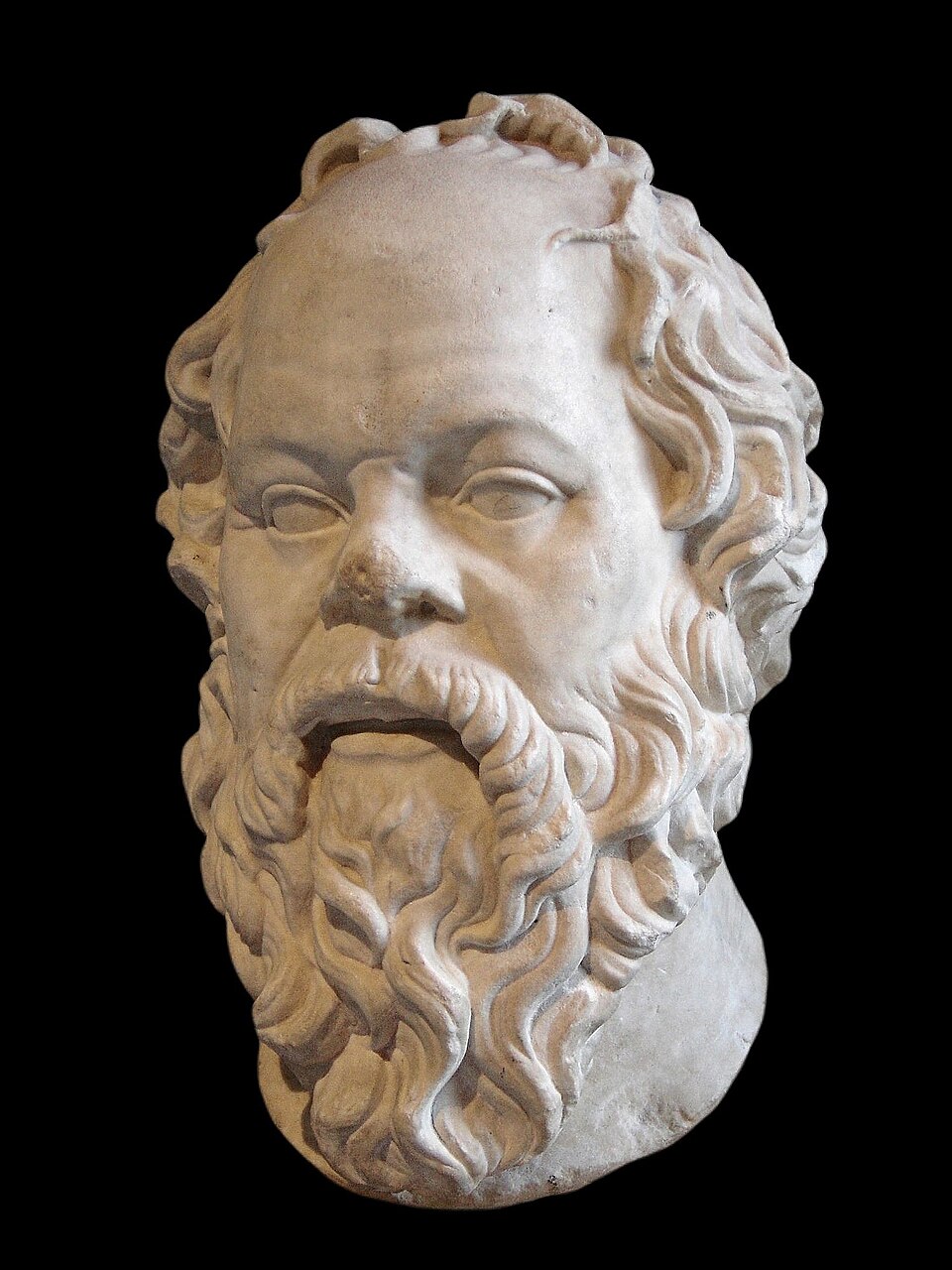
Socrates, Roman marble after a Greek bronze by Lysippos — the Louvre. He was, by every account including his own, remarkably ugly: snub nose, bulging eyes, the face of a satyr. Athens never forgave him for showing them that beauty was elsewhere.
the ugliest man in athens
he wrote nothing. he held no office he didn’t have to, founded no school, charged no fees, and owned, more or less, one cloak. and yet when the oracle of delphi — the god apollo speaking through his priestess — was asked whether any man alive was wiser than socrates, the answer came back: no one.
socrates’ response to being called the wisest man in the world is the whole story in miniature. he didn’t believe it. so he went looking for a counterexample — a politician, a poet, a craftsman, anyone wiser than himself — and interrogated them one by one in the agora. what he found instead were men who knew nothing but believed they knew much. and so he arrived at the famous, maddening conclusion:
i am wiser than this man; for neither of us really knows anything fine and good, but this man thinks he knows something when he does not, whereas i, as i do not know anything, do not think i do either. — plato, apology 21d
this — the knowledge of one’s own ignorance — was the only wisdom he ever claimed. athens found it insufferable. the young found it irresistible.
the gadfly
born around 470 BCE, son of a stonemason and a midwife, socrates served athens as a hoplite at potidaea, delium and amphipolis — where he saved the life of the young aristocrat alcibiades, marching barefoot through the ice while other men wrapped their feet in felt. but his true battlefield was conversation. he compared himself to his mother: a midwife of ideas, delivering other men’s thoughts and testing whether they were live births or phantoms.
his method was devastatingly simple. ask a man who claims to know what courage is — or justice, or piety — to define it. take his definition seriously. find the case where it breaks. repeat. the interlocutor, three definitions deep, discovers he cannot say what he was certain he knew. we still call it the socratic method, and it still works, and it still makes people furious.
i am that gadfly which god has attached to the state, and all day long and in all places am always fastening upon you, arousing and persuading and reproaching you. — plato, apology 30e
athens at the time was the school of greece — and its own worst pupil. the city had gilded itself under pericles, gambled its empire away in the peloponnesian war, suffered plague, coup, and the tyranny of the thirty. someone was going to pay for the humiliation. the bill was presented to the gadfly.
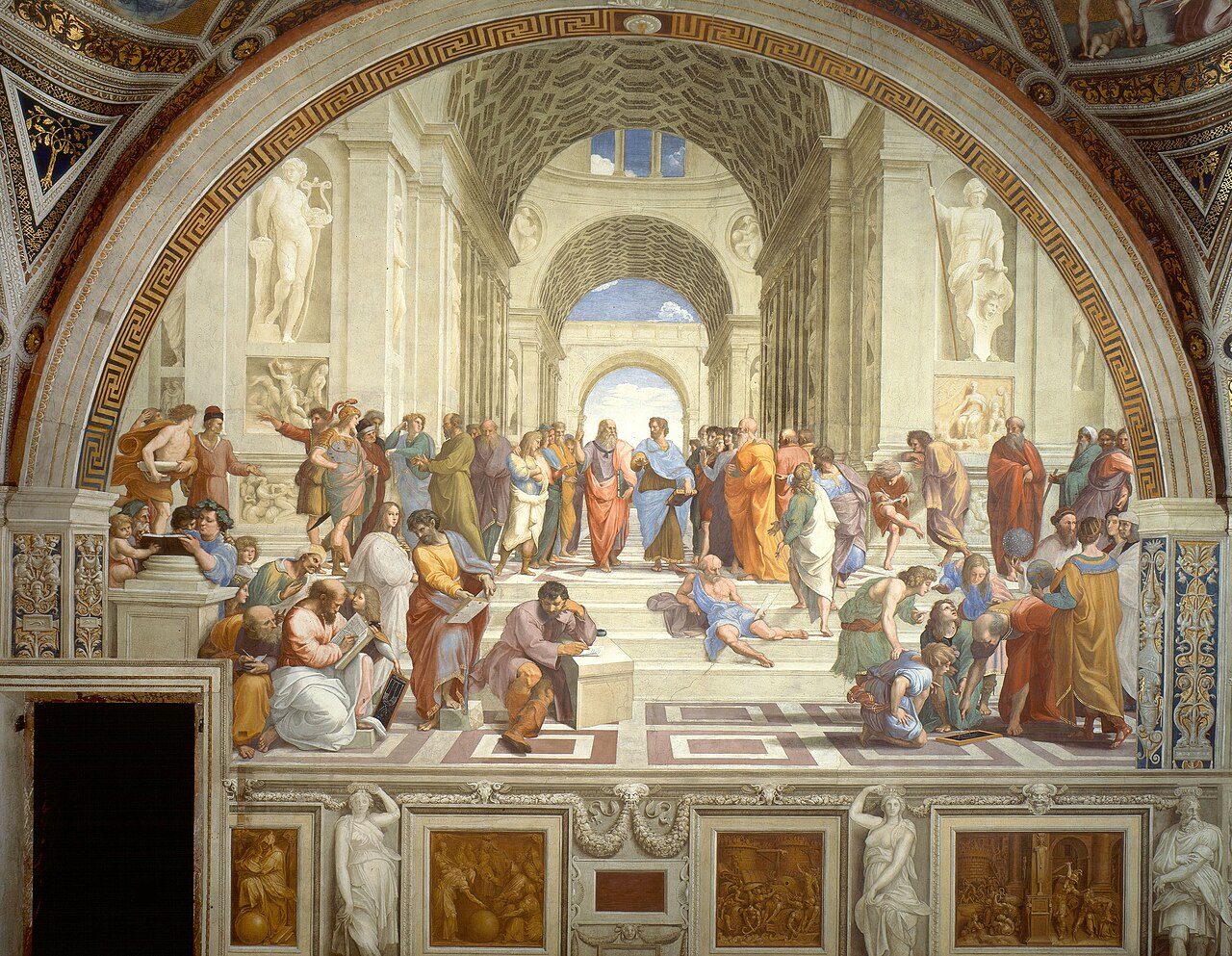
Raphael, The School of Athens (1509–11). Plato points up, Aristotle levels his palm at the world — and the whole scene exists because an ugly man in a cheap cloak asked stonecutters annoying questions. Socrates is there too, olive-clad on the left, counting off an argument on his fingers.
the trial
in 399 BCE, three citizens — meletus, anytus and lycon — brought the indictment: socrates is guilty of not believing in the gods the city believes in, of introducing new divinities, and of corrupting the young. the penalty proposed was death.
he was seventy. he stood before a jury of 501 athenians and refused every convention of the courtroom — no weeping family paraded before the jury, no rhetorical honey, no mercy asked. instead he told them, in effect, that they should be thanking him:
the unexamined life is not worth living. — plato, apology 38a
convicted by a margin of about sixty votes, he was invited to propose his own alternative penalty — the customary escape hatch, exile being the obvious play. socrates proposed, with a straight face, that athens reward him with free meals in the prytaneum for life, the honour reserved for olympic victors. pressed, he offered a fine his friends would pay. the jury, insulted, voted for death by a larger margin than it had voted for guilt.
the hour of departure has arrived, and we go our ways — i to die, and you to live. which is better, god only knows. — plato, apology 42a
the hemlock
his friends arranged an escape; escapes were practically expected. the jailer left the door loose, crito begged, the boat was ready. socrates declined — having lived seventy years under athens’ laws, he would not, he said, discredit them now by fleeing like a slave the one time they cut against him. the argument he gave crito — that you persuade the law or you obey it — is the founding document of civil obligation, and men have been arguing with it ever since.
on the appointed evening he bathed (to save the women the trouble of washing his corpse), dismissed his weeping household, and drank the cup of hemlock “quite readily and cheerfully,” as one would a toast. his friends broke down; he rebuked them — he had sent the women away, he said, precisely to avoid this. he walked until his legs grew heavy, lay down, and let the cold climb from his feet. his last words were a small, strange domestic instruction that scholars have chewed on for two and a half millennia:
crito, we owe a cock to asclepius. pay it, and do not neglect it. — plato, phaedo 118a
asclepius was the god of healing. you offered him a rooster when you were cured. of what, socrates did not say. 𐃏
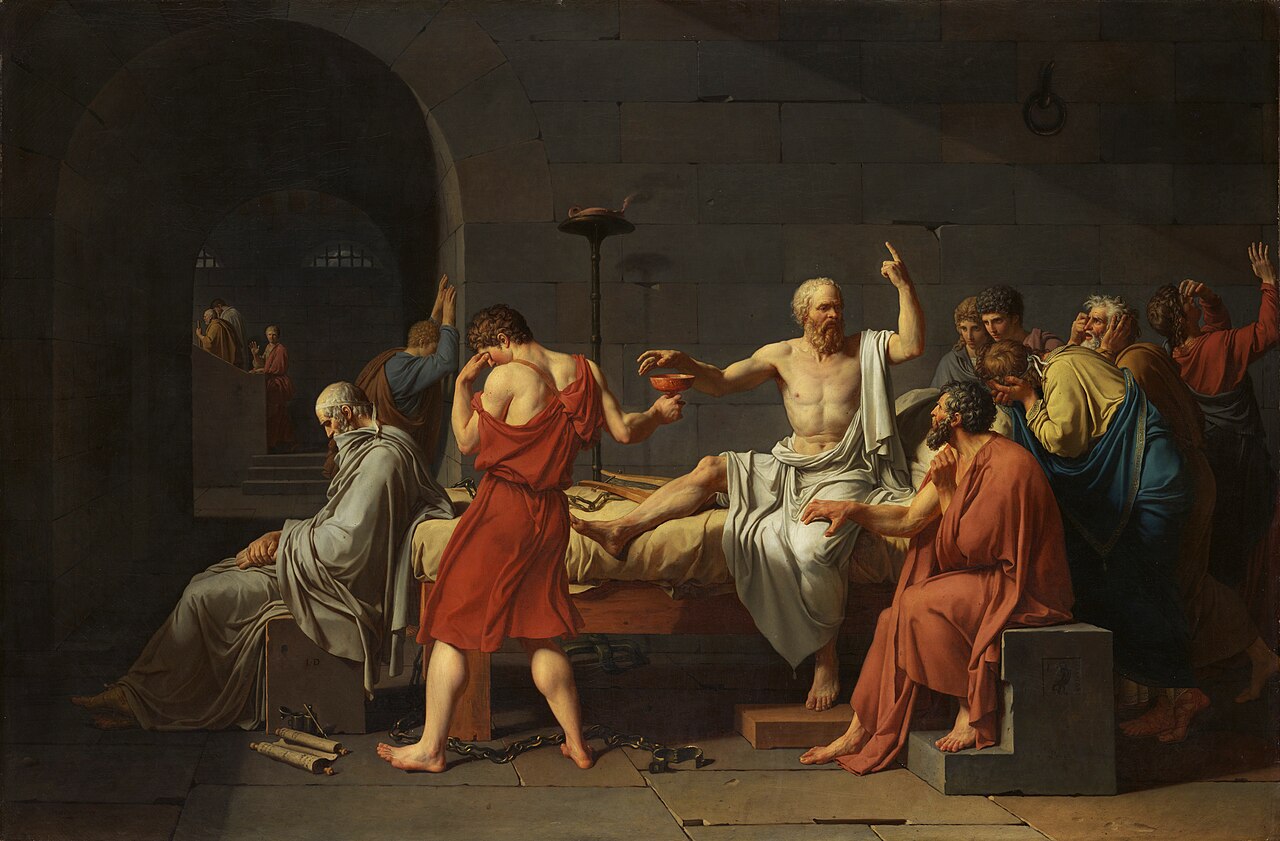
Jacques-Louis David, The Death of Socrates (1787) — the Met. David paints him mid-sentence, reaching for the cup without looking at it, one finger raised to heaven: still teaching. Plato — who in fact was absent, “sick” that day — sits aged and slumped at the foot of the bed, transcribing for eternity.
what was actually on trial
plato reports the verdict; history reversed it. within a generation athens regretted the sentence; within a century socrates was philosophy itself — the pivot on which the entire discipline turns, so completely that everything before him is just called pre-socratic. he is the schema of the intellectual martyr: the man who could have lived by shutting up, and reckoned the price too high.
a man who is good for anything ought not to calculate the chance of living or dying; he ought only to consider whether in doing anything he is doing right or wrong. — plato, apology 28b
he left no writings, so he survives the way he lived — in other people’s dialogue: plato’s socrates, xenophon’s socrates, even aristophanes’ cruel stage cartoon in the clouds, which socrates reportedly stood up during, cheerfully, so the tourists could compare the caricature with the original. the man is unrecoverable behind the portraits. the method is not. ask what the word means. take the answer seriously. find where it breaks.
repeat.
𐃏Backlinks (1)
1. Blog /blog/
welcome
this page is for my non-technical ramblings.
“If I had a world of my own, everything would be nonsense.” —The Hatter
Comments