A History of Coffee
Ancient Origins: Ethiopia and the Legend of Kaldi
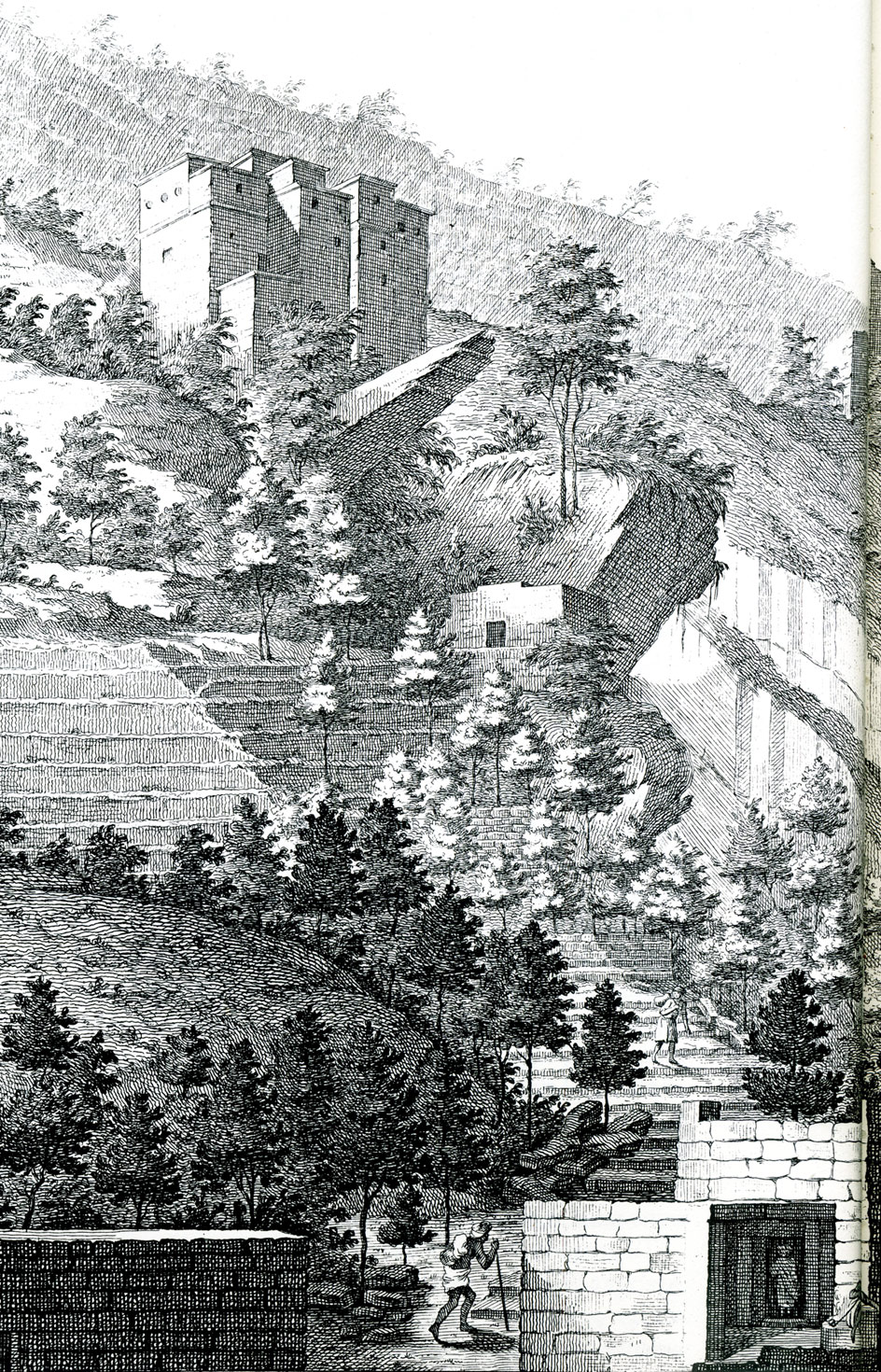
A coffee plantation in Yemen, drawn by Georg Wilhelm Baurenfeind during the Danish Arabia Expedition (1761–1767)
The story of coffee begins not in the porcelain cups of Viennese salons or the paper filters of modern drip machines, but in the forested highlands of Ethiopia, where the wild coffee plant—Coffea arabica—still grows beneath the canopy of ancient trees. The most enduring origin myth centres on a goatherd named Kaldi, who is said to have lived in the Ethiopian region of Kaffa around the 9th century. According to the legend, Kaldi noticed that his goats became unusually energetic and restless after eating the bright red berries of a particular shrub. The animals danced and leapt with an animation that puzzled their keeper, who decided to sample the berries himself. He too felt a surge of alertness and vitality.
Kaldi reportedly brought the berries to a local Sufi monastery, where the monks were sceptical. One account holds that an abbot, dismissing the berries as the work of the devil, cast them into a fire—only to be seduced by the rich, intoxicating aroma that rose from the flames. The roasted beans were raked from the embers, crushed, and dissolved in hot water, producing the world’s first cup of coffee. The monks discovered that the drink allowed them to remain awake through long hours of evening prayer, and word of the miraculous berry spread.
Whether or not Kaldi ever existed, the botanical evidence is unambiguous: Coffea arabica is indigenous to the Ethiopian highlands, where it has grown wild for millennia. The earliest human consumption of coffee likely took the form not of a brewed drink but of a crude energy food. Ethiopian tribes are known to have mixed crushed coffee berries with animal fat to create dense, portable balls of sustenance for long journeys and warfare—a practice that persisted into the 19th century. The Oromo people of Ethiopia may have been among the first to recognise the stimulant properties of the coffee plant, though no written records survive from these early encounters.
What is certain is that coffee’s psychoactive properties—its capacity to sharpen the mind, banish fatigue, and sustain concentration—were precisely the qualities that would propel it from an obscure East African shrub into one of the most consequential substances in human history.
The Arab World and the Birth of Qahwa
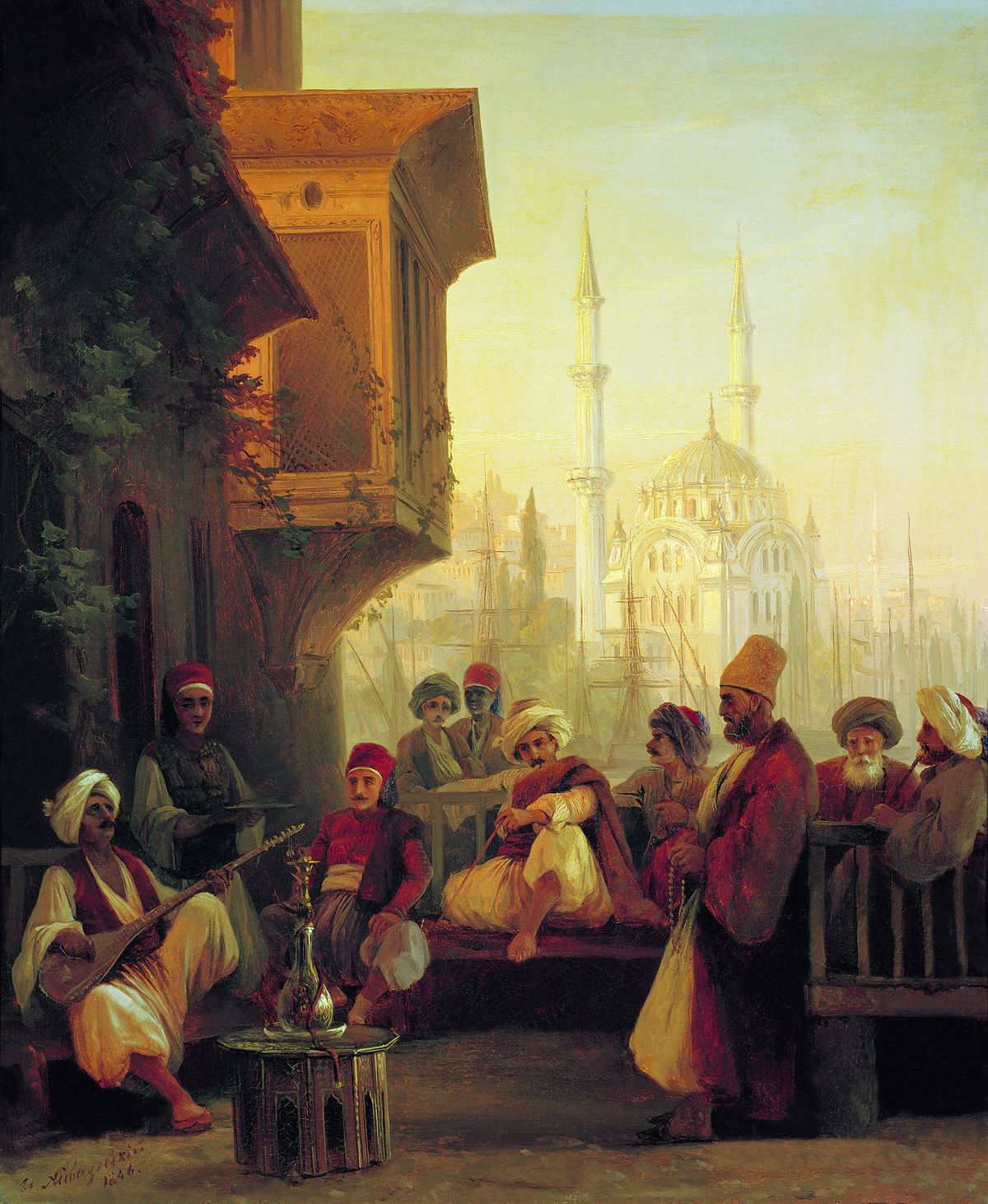
Coffee-house by the Ortakoy Mosque in Constantinople, Ivan Aivazovsky (19th century)
Coffee’s transformation from a wild Ethiopian berry into a cultivated, brewed beverage occurred across the Red Sea, in the arid mountains of Yemen. By the 15th century, Sufi monks in the Yemeni port city of Mocha had begun roasting and brewing coffee beans in a manner recognisable to modern drinkers. They called the drink qahwa—a word that originally referred to wine, and which the Sufis repurposed for this new, non-alcoholic stimulant that similarly loosened the tongue and animated the spirit. From qahwa descend the Turkish kahve, the Italian caffe, and the English coffee.
The Sufis valued coffee for a specific and sacred purpose: it sustained them through the dhikr, the long nocturnal devotional ceremonies in which practitioners chanted the names of God for hours on end. Coffee was, in this context, a spiritual technology—a substance that kept the faithful alert in the presence of the divine. The earliest credible historical references to coffee drinking appear in Sufi texts from mid-15th-century Yemen, where the mystic Ali ibn Omar al-Shadhili is sometimes credited as the drink’s patron saint.
From the monasteries, coffee moved rapidly into public life. By the early 16th century, qahveh khaneh—coffeehouses—had sprung up in Mecca, Medina, Cairo, Damascus, and Istanbul. These establishments were revolutionary social institutions. They were open to men of all classes and occupations, creating a space for conversation, poetry, music, chess, and the exchange of news in a way that the private majlis (salon) of the wealthy could not replicate.
Coffee is a drink of warmth and energy. One drinks it in pleasant company, and one discusses matters of consequence.
The Ottoman coffeehouses became known as mekteb-i irfan—“schools of the wise.” Travellers and diplomats marvelled at these establishments. The French botanist Antoine de Jussieu noted that the coffeehouse was “the academy of the people,” while European visitors to Constantinople reported that entire neighbourhoods were organised around their local coffeehouse. Storytellers, poets, and political commentators gathered in these spaces, and the Ottoman state grew increasingly wary of the subversive potential of so much unsupervised conversation.
The Trial of Coffee
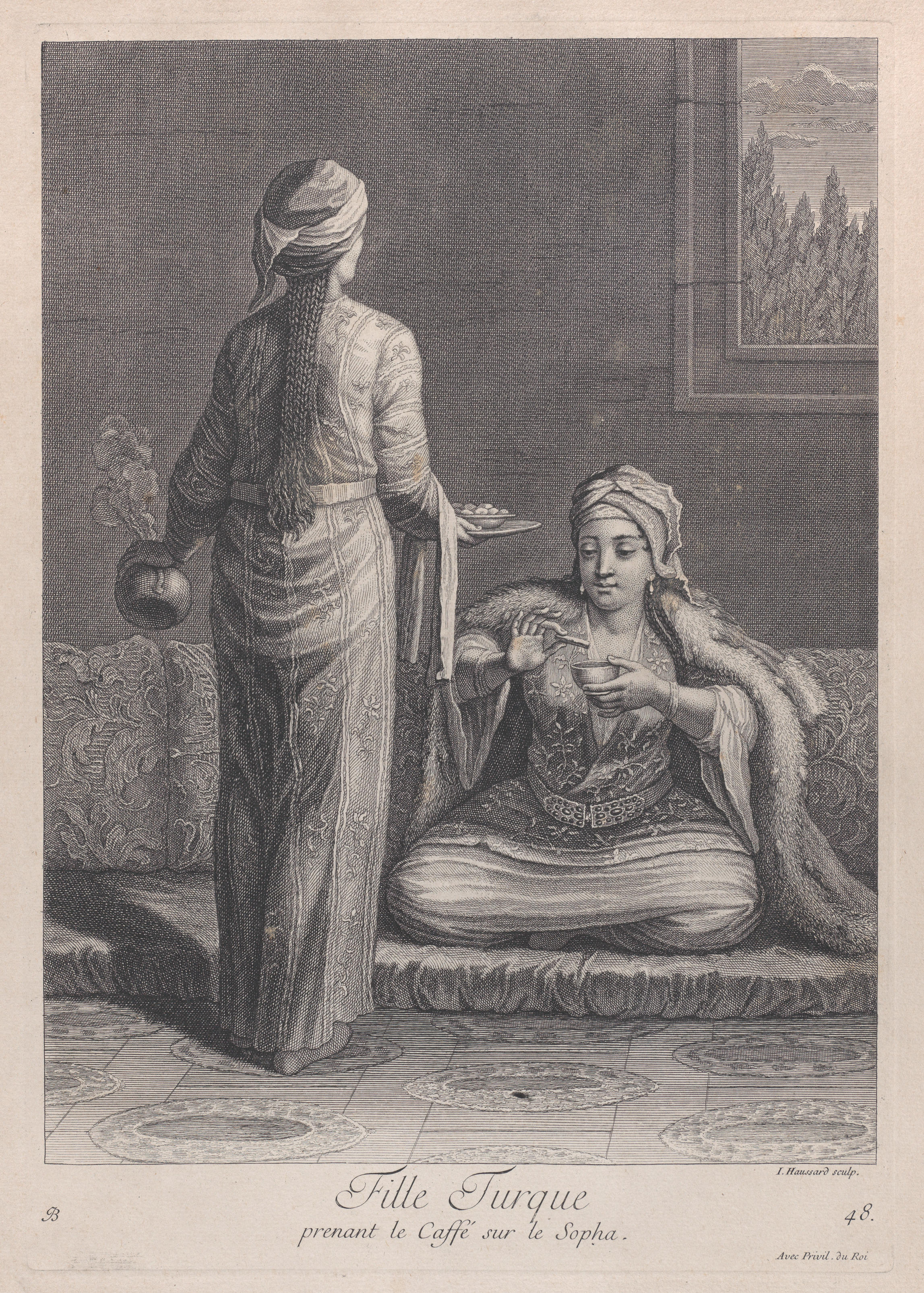
Fille Turque, prenant le Caffe sur le Sopha (Turkish girl taking coffee), after Jean Baptiste Vanmour, 1714–15
Coffee’s meteoric rise was not unopposed. The very qualities that made it beloved—its capacity to stimulate debate, loosen inhibitions, and draw crowds into public assembly—also made it dangerous in the eyes of political and religious authorities. The history of coffee is punctuated by a remarkable series of bans, trials, and attempted suppressions, none of which succeeded in the long run.
The most dramatic early confrontation occurred in Mecca in 1511. The city’s governor, Khair Beg, was alarmed by the coffeehouses that had proliferated in the holy city. Suspecting that the gatherings were hotbeds of political dissent—and concerned that the stimulant might constitute an intoxicant forbidden under Islamic law—Khair Beg convened a council of jurists and physicians to rule on the matter.
Account of the Mecca coffee trial, recorded by Abd al-Qadir al-Jaziri, c. 1558The Governor assembled the learned doctors and jurists, and put before them the question of this drink called qahwa, whether it be lawful or forbidden. Some declared it to be like wine in its effects, and therefore prohibited. Others held it to be a wholesome and permitted drink, no different from water sweetened with honey. The debate grew heated, and neither party would yield.
The council’s deliberations were fierce. Physicians testified that coffee was harmful to the body; others argued that the Prophet had never explicitly forbidden it. Khair Beg, having secured a favourable ruling, ordered the coffeehouses of Mecca closed and the sale of coffee banned. But the prohibition was short-lived: when the Sultan of Cairo learned of the edict, he was incensed. The Sultan was himself a coffee drinker, and he overruled Khair Beg’s ban, declaring that coffee was a legitimate and permissible beverage. Khair Beg was later executed—though for unrelated political offences, the timing was poetic.
Similar scenes played out across the Ottoman Empire. Murad IV banned coffeehouses in Constantinople in the 1630s, reportedly ordering that repeat offenders be sewn into leather bags and thrown into the Bosphorus. Yet the coffeehouses reopened as soon as enforcement slackened, proof that the appetite for coffee—and for the social world it created—was beyond the reach of any sovereign’s decree.
The most charming trial of coffee, however, occurred in Rome. When coffee arrived in Italy in the late 16th century, advisors to Pope Clement VIII urged him to condemn the drink as a “bitter invention of Satan,” a Muslim beverage unfit for Christian consumption. The Pope, before ruling, insisted on tasting the drink himself. According to the story—likely apocryphal but irresistible—Clement declared: “This Satan’s drink is so delicious that it would be a pity to let the infidels have exclusive use of it. We shall cheat Satan by baptising it.” With the papal blessing secured, coffee swept through Catholic Europe.
In England, the coffeehouses that had multiplied under the Restoration faced their own political suppression. In 1675, Charles II issued a proclamation banning coffeehouses, calling them places “where the disaffected met, and spread scandalous reports concerning the conduct of His Majesty and his Ministers.” The public outcry was so immediate and overwhelming that the ban was rescinded within eleven days—one of the shortest-lived prohibitions in English legal history.
The Coffeehouses of Europe
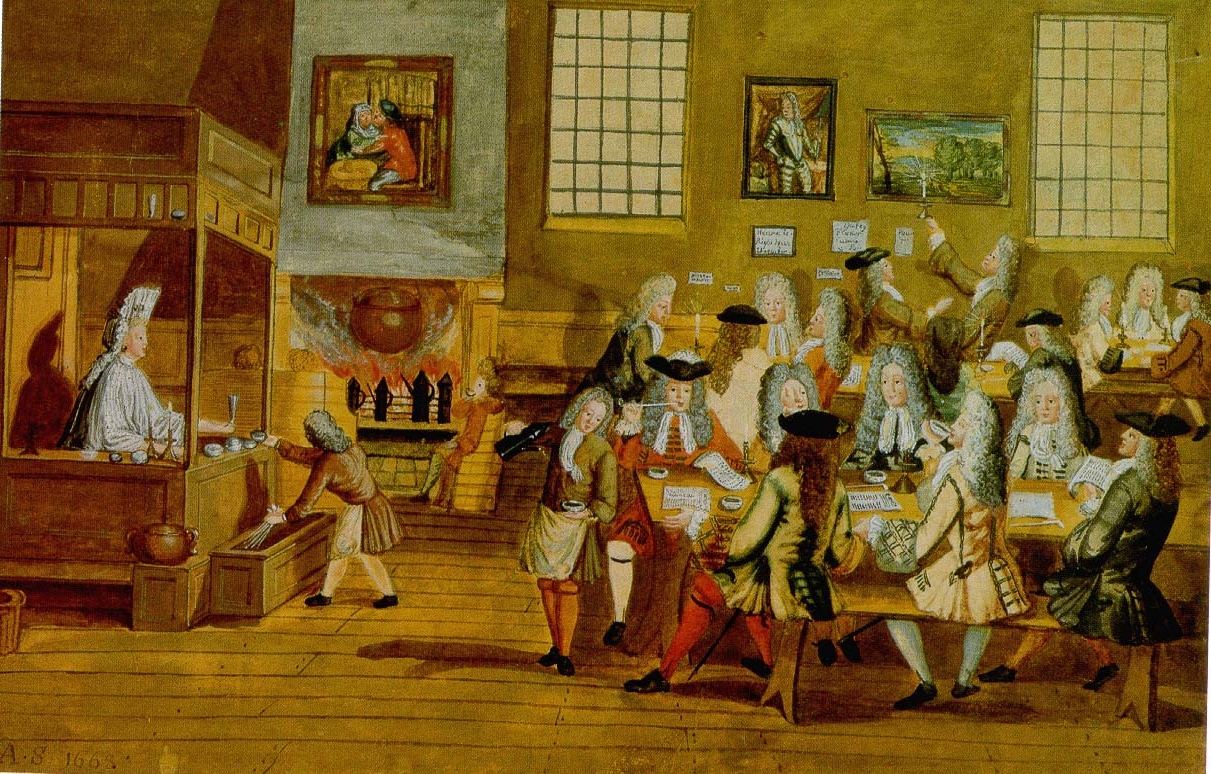
Interior of a London coffeehouse, 17th century
Coffee arrived in Europe through the trading ports of Venice, which had long served as the commercial bridge between East and West. The first European coffeehouse is generally believed to have opened in Venice in 1629, though informal coffee trading had taken place in the city’s markets for decades before. The drink spread rapidly northward: Oxford gained its first coffeehouse in 1650—established by a Lebanese man named Jacob at the Angel Inn—and London followed in 1652, when Pasqua Rosee, a servant of a Levant Company merchant, opened a stall in St Michael’s Alley, Cornhill.
The London coffeehouses of the late 17th and early 18th centuries were among the most consequential social institutions in modern history. For the price of a penny—the cost of a cup of coffee and admission—any man could enter, sit among merchants, scientists, writers, and politicians, and participate in the conversation of the day. This radical egalitarianism earned the coffeehouses the nickname “penny universities.”
Lloyd’s of London, the world’s most famous insurance market, began its life in Edward Lloyd’s coffeehouse on Tower Street in the 1680s, where ship owners, captains, and underwriters gathered to negotiate marine insurance. The London Stock Exchange traces its origins to Jonathan’s Coffee House in Change Alley, where stockjobbers posted share prices on the walls. The Royal Society held informal meetings at coffeehouses, and Joseph Addison and Richard Steele conceived The Spectator at Button’s Coffee House. The modern world was, in no small measure, brewed in these rooms.
Paris embraced coffee with equal fervour. Le Procope, established in 1686 by the Sicilian Francesco Procopio dei Coltelli, became the most celebrated cafe in Europe. Voltaire, Rousseau, Diderot, and Benjamin Franklin were among its patrons. Voltaire is reputed to have consumed between 40 and 50 cups of coffee per day—a staggering quantity that he maintained well into old age, dismissing concerns about his health with characteristic wit.
I have consumed this poison for eighty years, and I am not yet dead.
The Viennese coffeehouse tradition, meanwhile, traces its legendary origin to the Siege of Vienna in 1683. When the Ottoman army retreated, they left behind sacks of green coffee beans. A Polish-Ukrainian soldier named Jerzy Franciszek Kulczycki, who had served as a spy during the siege and understood Ottoman customs, is credited with opening Vienna’s first coffeehouse using the captured supplies. The Viennese refined the drink, filtering out the grounds and adding milk and sugar—innovations that helped define the European coffee tradition. The Kaffeehaus became central to Viennese cultural life, serving as the workspace and second home of writers, composers, and intellectuals for centuries to come.
In Germany, coffee’s growing popularity alarmed the establishment in a different way. Johann Sebastian Bach, with characteristic wit, composed his Kaffeekantate (Coffee Cantata, BWV 211) around 1735—a comic secular cantata in which a father tries to persuade his coffee-obsessed daughter to give up the drink. The daughter sings:
J.S. Bach, Coffee Cantata (BWV 211), 1735Ah! How sweet coffee tastes, more delicious than a thousand kisses, milder than muscatel wine. Coffee, I have to have coffee, and if someone wants to pamper me, ah, then bring me coffee as a gift!
The cantata was a satire of the moral panic surrounding coffee consumption, particularly among women. Frederick the Great of Prussia had issued edicts restricting coffee to the aristocracy, and the cultural anxieties that Bach lampooned were real—yet, as with every previous attempt to restrain coffee, the effort was futile.
The Global Trade: Plantations and Empire
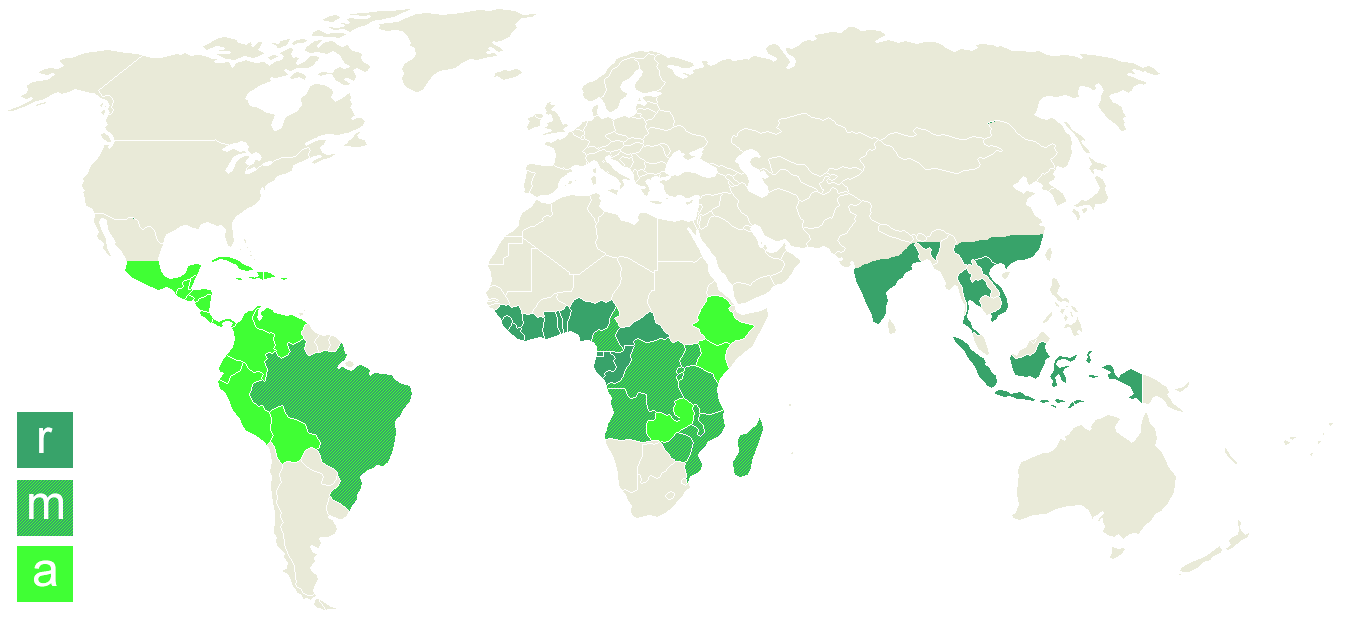
World map of Coffea arabica and Coffea robusta cultivation regions—the “Coffee Belt”
For centuries, the Arab world maintained a near-monopoly on coffee production. Yemeni merchants exported beans exclusively through the port of Mocha—a name that would become synonymous with coffee itself—and took care to ensure that no fertile seeds left their territory. Beans were parboiled or partially roasted before export to render them infertile. But monopolies, like prohibitions, are made to be broken.
The Dutch were the first to breach the Arabian coffee wall. In the 1610s, Dutch traders smuggled live coffee plants out of Yemen and established trial plantations in their colonies. By 1696, the Dutch East India Company (Vereenigde Oostindische Compagnie, or VOC) had successfully cultivated coffee on the island of Java in the Dutch East Indies (modern Indonesia). Java’s volcanic soils and tropical climate proved ideal for coffee cultivation, and within decades, the island had become one of the world’s largest producers. The word “Java” itself became—and remains—a colloquial synonym for coffee, particularly in American English.
The French followed with one of the most dramatic episodes in agricultural history. In 1723, a young naval officer named Gabriel de Clieu transported a single coffee plant from the Jardin des Plantes in Paris to the Caribbean island of Martinique. The voyage was perilous: the ship was becalmed, water rations ran short, and de Clieu reportedly shared his own meagre water allowance with the plant to keep it alive. From that single seedling descended the vast coffee plantations of the French Caribbean and, eventually, much of Central and South America.
The Portuguese brought coffee to Brazil in 1727, through an act of espionage as colourful as de Clieu’s voyage. Francisco de Melo Palheta, a Brazilian military officer, was sent to French Guiana ostensibly to mediate a border dispute. He returned with coffee seedlings—legend holds that they were smuggled out in a bouquet of flowers given to him by the French governor’s wife, with whom he had conducted a strategic affair. Brazil would eventually become the world’s largest coffee producer, a position it has held almost continuously since the mid-19th century.
The establishment of colonial coffee plantations was inseparable from the economics of empire and coerced labour. In Java, the Dutch imposed the cultuurstelsel (cultivation system), requiring Indonesian farmers to devote a portion of their land to export crops including coffee. In Brazil, coffee production was built on the labour of enslaved Africans until abolition in 1888, and afterwards on the exploitation of immigrant workers. The “Coffee Belt”—the tropical band between the Tropics of Cancer and Capricorn where coffee thrives—became a map of colonial extraction, a geography of immense wealth flowing from the Global South to the coffeehouses and markets of Europe.
Java: From Island to Programming Language

Duke, the Java programming language mascot—a direct homage to the coffee that fuelled its creation
The island of Java gave its name not only to a style of coffee but, unexpectedly, to one of the most widely used programming languages in the world. The connection is neither metaphorical nor coincidental—it is a story about the culture of software engineering and the beverage that sustains it.
In 1991, a team at Sun Microsystems led by James Gosling began work on a programming language initially called Oak, intended for interactive television and embedded systems. The language was designed to be platform-independent, secure, and robust—qualities that would eventually make it the backbone of enterprise software, Android applications, and the early World Wide Web. But the name “Oak” was already trademarked by another technology company, and a new name was needed.
The naming story has become legend in software circles. The development team at Sun Microsystems was, by all accounts, fuelled by prodigious quantities of coffee—much of it Java coffee, sourced from the Indonesian island. During a brainstorming session in January 1995, the team compiled a list of candidate names. “Java” emerged as the favourite, evoking energy, warmth, and the aromatic experience of the drink that had accompanied countless hours of late-night coding. The language’s logo—a steaming coffee cup—made the connection explicit and permanent.
Java was officially released in 1995 with the slogan “Write Once, Run Anywhere,” and its coffee-cup branding became one of the most recognisable logos in technology. The choice of name was inspired: just as coffee had become a universal daily ritual transcending cultures and geographies, Java the language aspired to be a universal platform transcending hardware and operating systems. The name also tapped into a deeper cultural truth—that the history of computing is, in no small part, a history of caffeine consumption. The stereotype of the programmer sustained by coffee is not merely a joke; it reflects a genuine symbiosis between a stimulant that sharpens focus and a profession that demands sustained concentration.
Coffee as Commodity: Futures, Prices, and Ubiquity
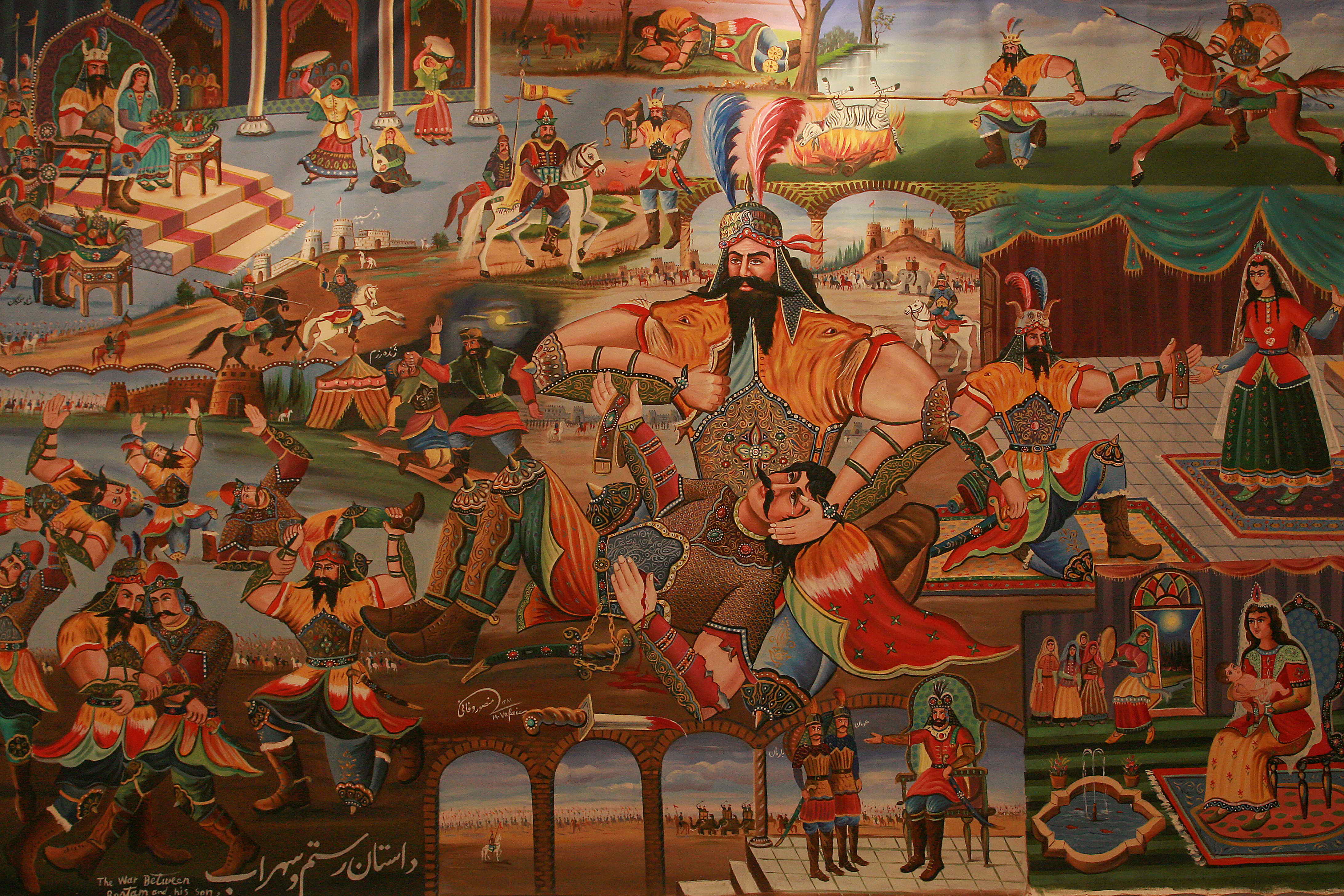
A Persian miniature displayed in a traditional qahveh khaneh (coffeehouse) in Tehran—coffee culture endures from the ancient to the modern
Coffee is, by some measures, the second most traded commodity on Earth after crude oil—a statistic that captures the sheer scale of the global coffee economy. Over two billion cups of coffee are consumed every day worldwide, and the industry supports the livelihoods of an estimated 125 million people across the producing nations of the Coffee Belt.
The financial architecture of the modern coffee trade is centred on the Intercontinental Exchange (ICE), where Arabica coffee futures are traded under the ticker symbol KC. Robusta futures trade on ICE Europe (formerly LIFFE) in London. These futures contracts—standardised agreements to buy or sell coffee at a future date—allow producers, roasters, and speculators to hedge against the radical price volatility that has always characterised coffee markets.
Arabica coffee futures surged to historic highs in late 2024 and into 2025, driven by severe drought in Brazil’s key growing regions of Minas Gerais and Sao Paulo, combined with supply disruptions in Vietnam (the world’s largest Robusta producer). Prices on the ICE KC contract exceeded $4.00 per pound in early 2025—more than double the 2023 average—before retreating modestly. These price shocks have cascaded through the supply chain, driving up retail coffee prices worldwide and intensifying debate about the vulnerability of a global industry built on tropical monoculture and just-in-time logistics.
The 21st century has also witnessed the rise of the “third wave” of coffee—a movement that treats coffee not as a commodity but as an artisanal product, analogous to wine. Third-wave roasters emphasise single-origin beans, direct trade relationships with farmers, transparent pricing, and meticulous brewing techniques. Companies like Blue Bottle, Intelligentsia, and Stumptown pioneered this approach in the United States, while specialty coffee culture has flourished in cities from Melbourne to Tokyo to Addis Ababa—where Ethiopian coffee, having travelled the world, has returned home as a premium product.
Yet the third wave exists alongside—and is dwarfed by—the industrial scale of global coffee chains. Starbucks, founded in Seattle in 1971 and transformed by Howard Schultz into a global brand in the 1980s and 1990s, operates over 38,000 stores in more than 80 countries. The ubiquity of the green siren logo is itself a testament to coffee’s unique cultural position: no other agricultural commodity has so thoroughly colonised public space, daily routine, and social ritual across virtually every culture on Earth.
From the goatherd Kaldi’s dancing flock in the Ethiopian highlands to the futures trading floors of New York and London; from the Sufi monasteries of 15th-century Yemen to the specialty pour-over bars of 21st-century Brooklyn; from the trial in Mecca’s courts to the papal blessing in Rome; from the volcanic slopes of Java to the steaming coffee-cup logo of a programming language—the history of coffee is a history of the modern world itself. It is a story of trade and empire, of prohibition and irrepressible desire, of intellectual revolution and daily ritual. Two billion cups a day, and counting.
Backlinks (2)
1. V60 Pourovers /roam/coffee/v60/
Everything about the Hario V60 is a refusal to make decisions on your behalf. It is a cone, some ribs, and a hole — no valve, no basket geometry slowing the water down, no reservoir metering the flow. The dripper controls nothing, which means the person holding the kettle controls everything: grind, temperature, ratio, and the shape of the pour itself. How the bean got to your kitchen in the first place is told in a history of coffee; this treatise is about the last four minutes of that thousand-year journey.
Comments