V60 Pourovers
Everything about the Hario V60 is a refusal to make decisions on your behalf. It is a cone, some ribs, and a hole — no valve, no basket geometry slowing the water down, no reservoir metering the flow. The dripper controls nothing, which means the person holding the kettle controls everything: grind, temperature, ratio, and the shape of the pour itself. How the bean got to your kitchen in the first place is told in a history of coffee; this treatise is about the last four minutes of that thousand-year journey.
The Instrument
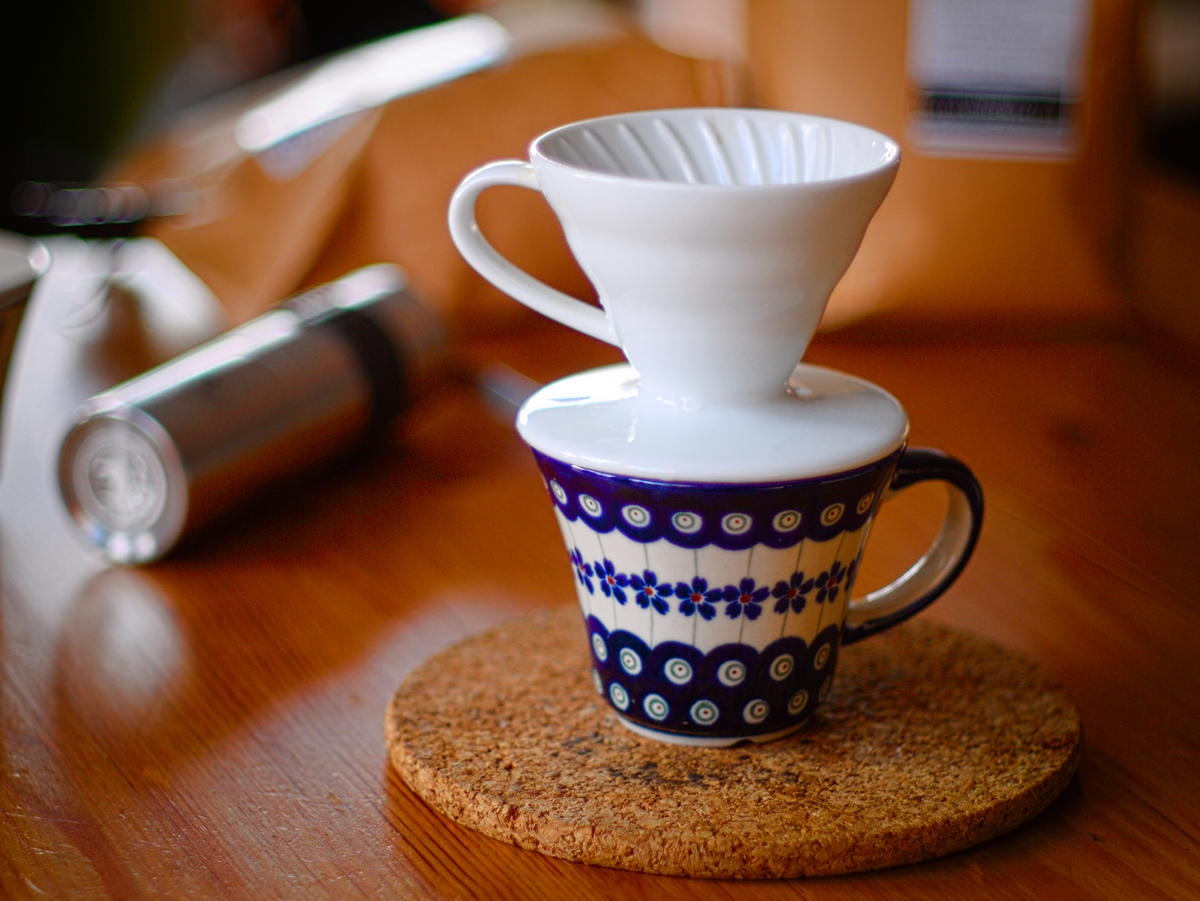
A ceramic V60 mid-drawdown. Photograph: Olgierd Rudak, CC BY 2.0, via Wikimedia Commons.
Hario began life in 1921 as the Hiromu Shibata Works of Kanda-Sudacho, Tokyo, a maker of laboratory glassware — beakers, flasks, petri dishes. The name is a contraction of hari no ō, “king of glass”, and the company melted its first proprietary heatproof formulation in 1949. The V60 itself is a latecomer: designed in 2004 and released commercially in 2005, the name records exactly what it is — a V-shaped cone whose included angle is \(60^{\circ}\). 𐃏 Three design decisions do all of the work:
- The cone. A conical bed is deepest at its centre, so water converges toward the middle and every particle sits under a meaningful column of liquid — unlike a flat-bottomed basket, where the bed is shallow and uniform.
- The spiral ribs. The moulded ribs hold the paper off the wall, leaving an air channel so the bed can expand upward and liquid can escape along the sides rather than vacuum-sealing the filter to the cone. The spiral (rather than straight) ribbing was the decisive 2004 refinement.
- The single open hole. Instead of several small holes that throttle the flow, one oversized aperture lets the paper tip protrude freely. Drainage is therefore limited by the coffee bed itself, not the brewer: pour fast for a lighter cup, slow for a richer one.
The dripper comes in ceramic, glass, stainless steel, copper, and polypropylene, and here the cheapest one wins. 𐃏 Ceramic and glass have high heat capacity: unless aggressively preheated they pull heat out of the slurry for the first minute of the brew, exactly when extraction matters most. Polypropylene has low thermal mass and low conductivity, steals almost nothing, and needs no preheat — which is why James Hoffmann, Scott Rao, and most World Brewers Cup competitors reach for the plastic one (Hoffmann, James, 2022).
The Chemistry of Extraction
The V60 is a percolation brewer: fresh water passes continuously through the bed, so the concentration gradient between particle and liquid stays steep and extraction runs fast. Immersion brewing — the French press, the cupping bowl — lets the grounds sit in a single mass of water whose strength climbs until extraction self-limits: more even, more forgiving, but capped lower and muddier with fines. Percolation trades that safety for speed and clarity, and inherits two failure modes in exchange: channelling, where water carves preferential paths and over-extracts their walls while bypassing the rest of the bed, and fines migration, where sub-\(100\,\mu\mathrm{m}\) particles wash downward, clog the filter, and stall the drawdown (Rao, Scott, 2010).
What dissolves, dissolves in order. First out are the highly soluble organic acids — citric, malic, chlorogenic — and the light fruity aromatics; then the sugars and Maillard products that read as sweetness and body; last, and slowest, the bitter phenolics and chlorogenic-acid lactones that taste astringent and dry (Illy, Andrea and Viani, Rinantonio, 2005). Under-extraction therefore tastes sour, sharp, and thin; over-extraction tastes bitter, drying, and hollow. The brewer’s job is to stop in the middle.
The middle has numbers. Define the extraction yield — the fraction of the dry dose that ended up dissolved in the cup:
\[ \mathrm{EY} = \frac{\mathrm{TDS} \times m_{\mathrm{beverage}}}{m_{\mathrm{dose}}} \]
where TDS is the total dissolved solids of the beverage as a mass fraction. 𐃏 In the 1950s Ernest Lockhart of the Coffee Brewing Institute surveyed American drinkers and mapped their preferences onto a chart of strength against extraction (Lockhart, Ernest Eral, 1957); his descendants at the Specialty Coffee Association still define the Golden Cup as an extraction yield of 18–22% at a beverage strength of 1.15–1.35% TDS.1
The chart carries one structural insight: once you fix a brew ratio, strength and extraction are no longer independent. To first order \(\mathrm{TDS} \approx \mathrm{EY} \times m_{\mathrm{dose}} / m_{\mathrm{water}}\), so a given ratio confines the brew to a diagonal line through the chart — the pour only chooses where along that line you stop.
Technique
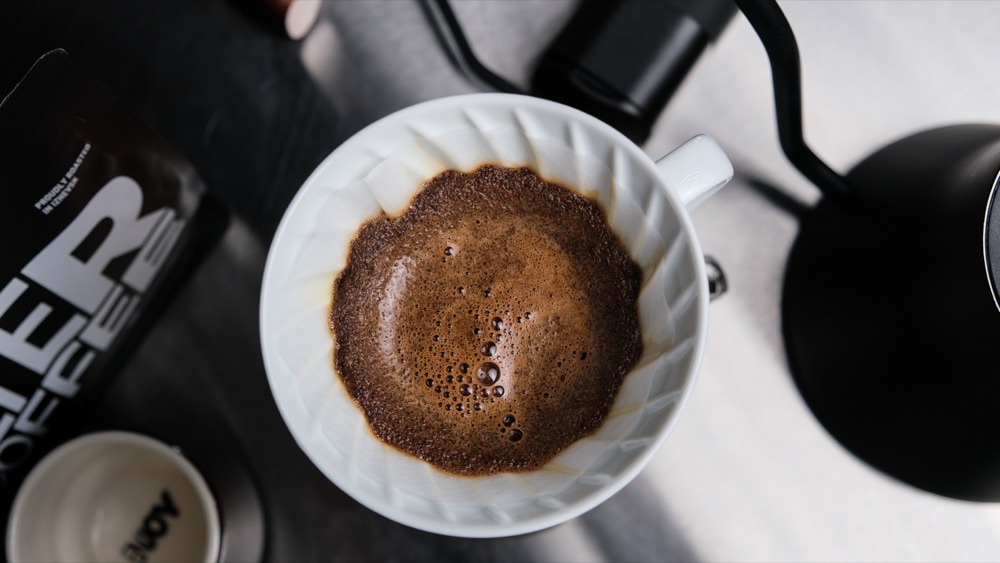
The bloom: trapped roast gases escape as the dry bed is first wetted. Photograph: Indigo.udm, CC BY 4.0, via Wikimedia Commons.
Every V60 recipe, whatever its politics, agrees on the opening move: the bloom. Roasting generates carbon dioxide that stays trapped in the bean’s cellular matrix, and escaping \(\mathrm{CO_2}\) repels water from the particle surfaces — bubbles block pores, lift the bed, and leave patches of dry grounds that finish the brew sour and underdeveloped. So you pour two to three times the coffee’s weight in water, wait 30–45 seconds while the gas boils off, and only then begin brewing in earnest. 𐃏 The rest of the standard settings: a ratio of 1:15 to 1:17 (the SCA standard is \(55\ \mathrm{g/L} \pm 10\%\)), a medium-fine grind, and water at \(90\)–\(96\,^{\circ}\mathrm{C}\) — hotter for light roasts, whose dense matrix needs the help, cooler for dark roasts, which extract easily and turn bitter (Hoffmann, James, 2014).
Agitation is the contested variable. Stirring and swirling increase extraction and evenness — they break up clumps, knock grounds off the walls, and resettle the bed — but late or violent agitation drives fines into the filter and stalls the drawdown. Rao’s rule is all agitation early, none late; Hoffmann finds a gentle swirl more repeatable than a spoon (Rao, Scott, 2010). The universal diagnostic comes at the end: a flat bed after drawdown is the signature of even percolation, while a crater or a high tide-line of stranded grounds betrays channelling.
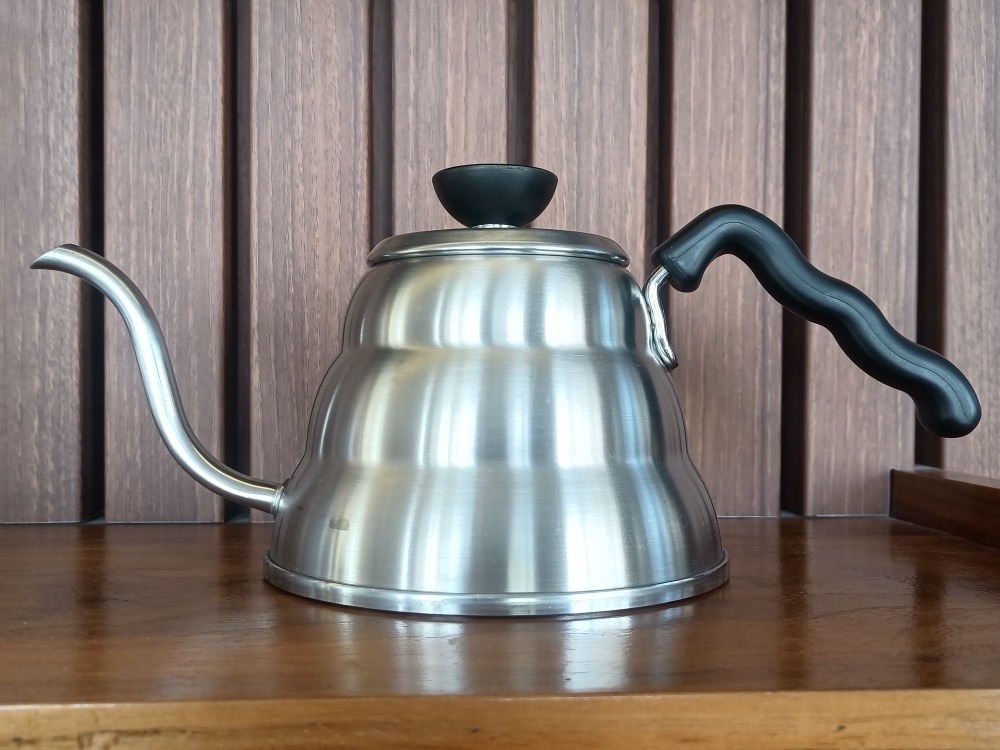
The gooseneck kettle — here Hario’s own Buono — exists to make pour rate and placement controllable. Photograph: Fumikas Sagisavas, CC0, via Wikimedia Commons.
The Canon
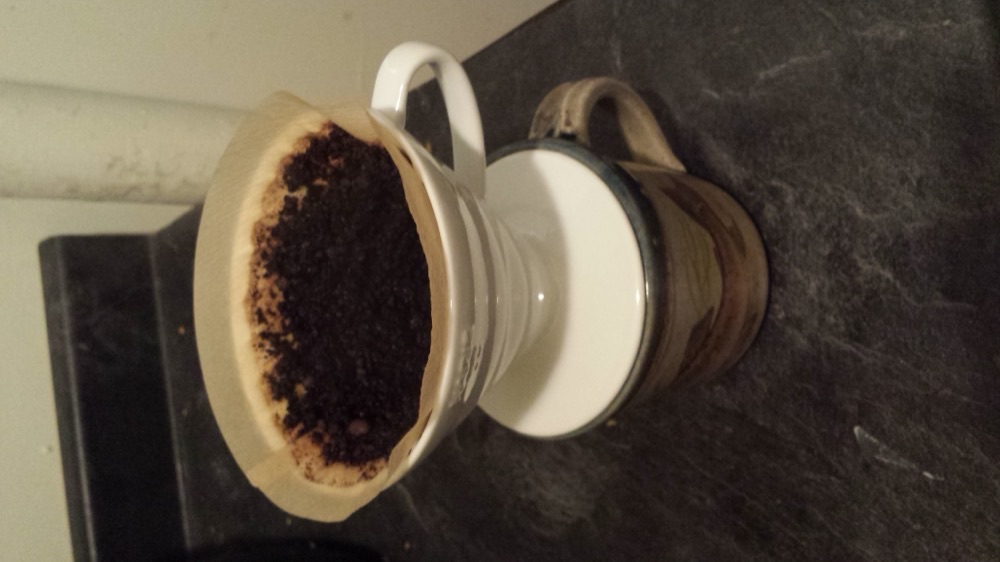
Pouring in slow spirals over a Hario cone. Photograph: GorillaWarfare, CC BY-SA 1.0, via Wikimedia Commons.
Four recipes span the design space. Matt Perger took the 2012 World Brewers Cup with a small, hot, fast brew that embraced fines. Tetsu Kasuya won the 2016 title in Dublin with the 4:6 method and a deliberately coarse grind: the first 40% of the water is split into two pours whose balance tunes acidity against sweetness, the remaining 60% is split into one to three pours that set strength — a recipe you can retune without touching the grinder. 𐃏 Scott Rao brews the anti-recipe: stir the bloom to full wetting, then one continuous pour and a final settling spin, maximum evenness with minimum ceremony. James Hoffmann’s 2019 Ultimate V60 sits in the middle and is probably the default recipe of the internet.
| method | year | dose | water | ratio | temperature | structure of the pour | finished |
|---|---|---|---|---|---|---|---|
| Perger | 2012 | 12 g | 200 g | 1:16.7 | \(97\,^{\circ}\mathrm{C}\) | bloom 50 g and stir; 50 g at 0:30; 100 g at 1:00 | 2:20 |
| Kasuya 4:6 | 2016 | 20 g | 300 g | 1:15 | \(92\,^{\circ}\mathrm{C}\) | five pours of 50/70/60/60/60 g at 45 s intervals | 3:30 |
| Rao | 2017 | 22 g | 360 g | 1:16.4 | \(94\,^{\circ}\mathrm{C}\) | bloom 66 g with a deep stir; one continuous pour; settling spin | 2:45 |
| Hoffmann | 2019 | 30 g | 500 g | 1:16.7 | off the boil | bloom 60 g and swirl; to 300 g by 1:15; to 500 g by 1:45; swirl | 3:30 |
That four champions disagree this thoroughly — coarse against fine, five pours against one, \(92\,^{\circ}\mathrm{C}\) against boiling — is the strongest evidence for Hario’s design premise: the cone imposes so little that a recipe is genuinely a point in a large open space, not a perturbation of the manufacturer’s defaults.
The Water
The cup is 98.6% water, and the dissolved minerals in that water are reagents, not bystanders. Hendon and the Colonna-Dashwoods showed that the cations do the extracting — magnesium in particular binds the desirable flavour compounds effectively — while bicarbonate sits on the other side of the ledger, buffering away the bright acids that distinguish a light roast (Hendon, Christopher H. and Colonna-Dashwood, Lesley and Colonna-Dashwood, Maxwell, 2014). Too much alkalinity flattens the cup; too little leaves it sharp and sour-leaning (Colonna-Dashwood, Maxwell and Hendon, Christopher H., 2015). The SCA’s target water sits at 50–175 ppm hardness (as \(\mathrm{CaCO_3}\)) with alkalinity near 40 ppm, no chlorine, and a pH near 7 — which is why the same beans and the same recipe brew differently in different cities.
Four minutes, one moving part, and the moving part is you.
see also
- a history of coffee — how the bean crossed the Red Sea, survived its trial in Mecca, and conquered the world
- the Specialty Coffee Association — keepers of the Golden Cup standard and the modern brewing control chart
References
Colonna-Dashwood, Maxwell and Hendon, Christopher H. (2015). Water for Coffee, Self-published.
Hendon, Christopher H. and Colonna-Dashwood, Lesley and Colonna-Dashwood, Maxwell (2014). The Role of Dissolved Cations in Coffee Extraction, Journal of Agricultural and Food Chemistry.
Hoffmann, James (2022). How to Make the Best Coffee at Home, Mitchell Beazley.
Hoffmann, James (2014). The World Atlas of Coffee: From Beans to Brewing, Mitchell Beazley.
Illy, Andrea and Viani, Rinantonio (2005). Espresso Coffee: The Science of Quality, Elsevier Academic Press.
Lockhart, Ernest Eral (1957). The Soluble Solids in Beverage Coffee as an Index to Cup Quality, Coffee Brewing Institute.
Rao, Scott (2010). Everything but Espresso: Professional Coffee Brewing Techniques, Scott Rao.
The rectangle is not eternal: in 2023–24 the SCA and the UC Davis Coffee Center published a revised brewing control chart that replaces the single ideal box with preference-dependent zones, acknowledging that modern light-roast drinkers happily sit outside Lockhart’s 1950s consensus. ↩︎
Comments