λambda
λambda — Learner-Adaptive, Marks-Bound Drilling Agent — is a study tool that keeps a working image of your mind: what you hold, where you stall, and which exam marks each gap is costing you. It probes before it teaches, teaches only what you missed, and drills until the fix survives a variant. The protocol is open source at lambda-agent; the hosted study lounge is being built at lambda.fatfort.com.
■ your mind, as λ understands it ■ what the Language Model knows that is relevant to you ■ everything else the Language Model knows
The mind image
Most study software stores your schedule. λambda stores your misses —
each stall becomes a misconception atom: what you knew, the exact move you
were missing, and which real problems exercise it. Mastery is a state
machine, and the only way a concept reaches locked is by answering a
variant correctly after being taught — having been told is never
counted as knowing. The whole image is plain markdown in a folder, so it
diffs, greps, and versions in git like anything else you own.
Marks-bound routing
Before drilling, λambda indexes your actual course materials — problem sets, past papers, quizzes — into a map that routes every question to the marks it serves. A timeboxed session spends its minutes where the marks are, highest first. Two details that took real use to get right:
- Solutions are grounding, not content. The map-builder reads solution sets to confirm marks and intended method, but never leaks their text into questions or teaching — so the drill stays a drill.
- Lecture transcripts are an emphasis signal. Past papers show what an earlier offering examined; the transcript shows what this lecturer stressed, skipped, or said out loud about the exam. The map weights accordingly.
The vault is the API
There is no black box to trust. Everything the tutor knows about your child lives in plain, readable files — the session, the verdicts, the map of what has been learned — and answers are checkbox ticks in that file. A tick is an answer no matter what ticked it or when: close the app, tick boxes offline, and the next session grades them on open. Because the files are the product, any front-end that renders them conforms; the native Lambda Mind app below is one, the open-source Obsidian path (further down) is another. Nothing is locked in, and you can read your child’s entire learning record in a text editor.
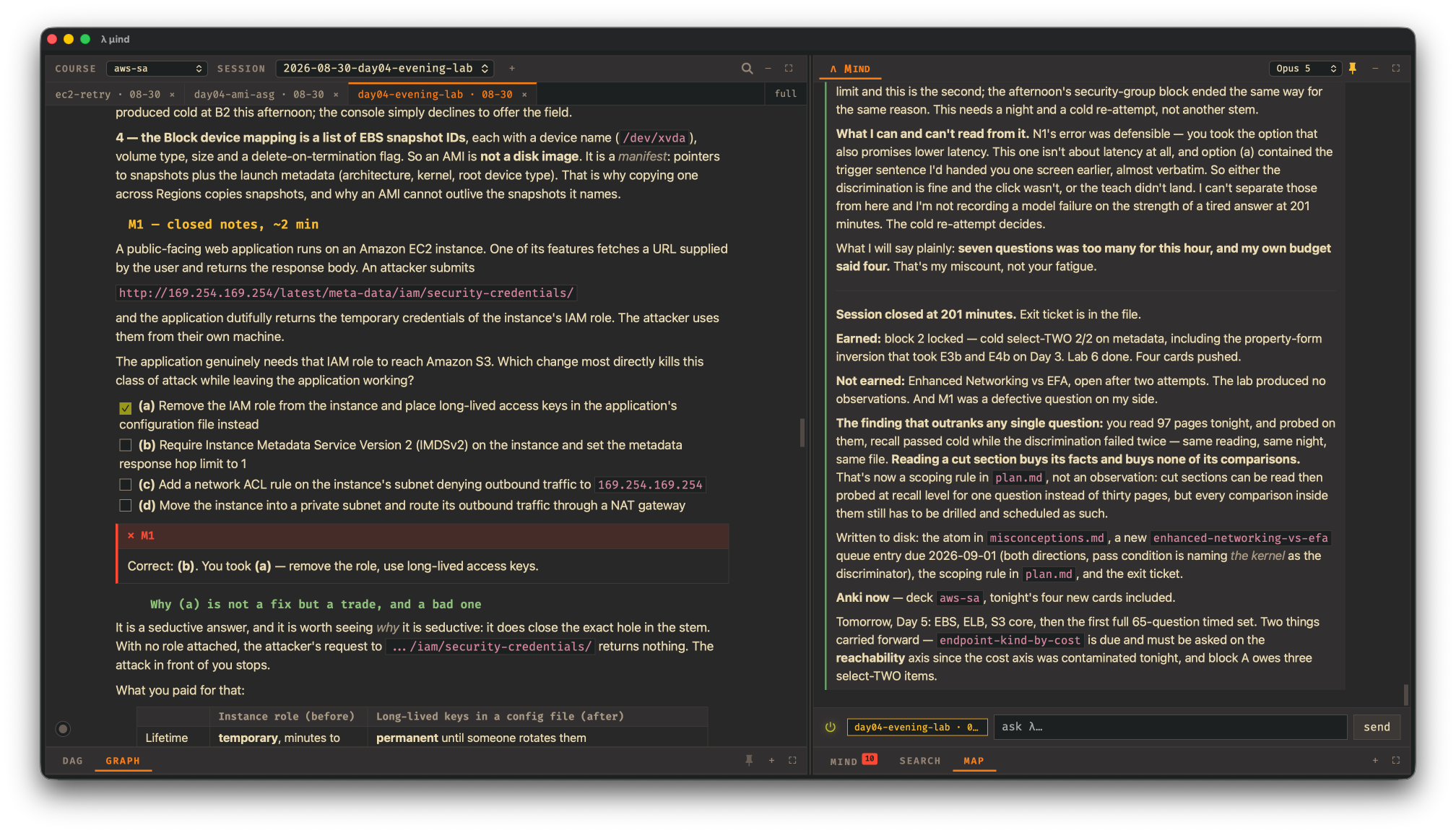
Lambda Mind, the native study app. Left: a live exam-style question in the session, ticked and awaiting its verdict. Right: the tutor’s reasoning and the running record of what was earned and what still owes a re-attempt.
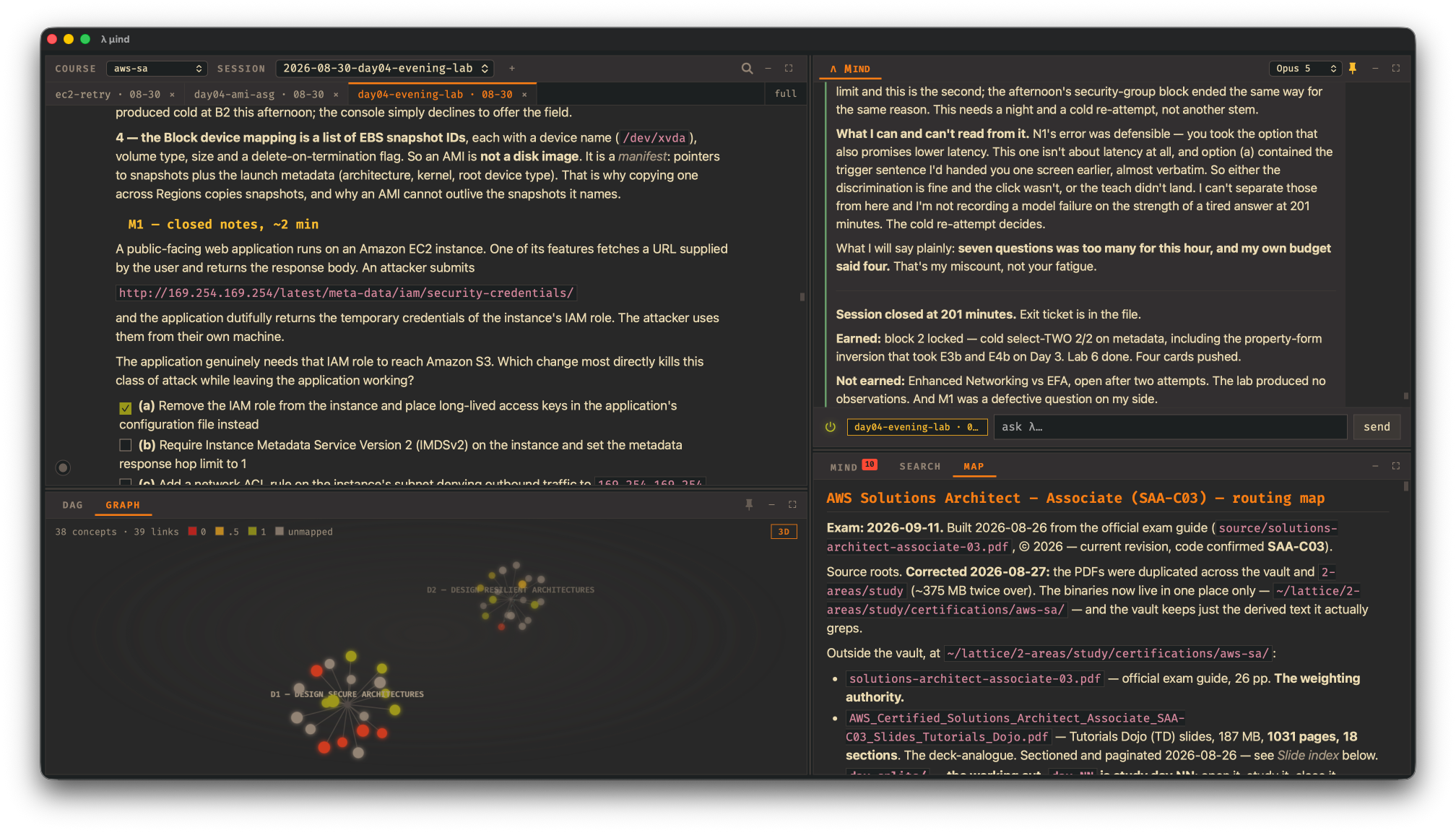
The same app showing the course map as a graph — each dot a concept, its colour the child’s current mastery (red not yet, green solid). Weak areas are visible at a glance, so time is spent where the marks are.
The pedagogy is load-bearing
The design follows the testing-effect literature (Roediger & Karpicke 2006) rather than fighting it: retrieval beats re-reading, generation beats recognition. So the agent’s output is rationed — zero words after posing a question, capped verdicts, teaching steps that end with work for the learner — and the layers stay separate: multiple choice locates the edge of what you know, free recall (Anki, if you use it) retains it, and cold blank-page reconstruction proves it. λambda refuses to become a summariser, because summaries feel like progress and test like nothing.
The method owes a debt to Eero Alvar’s How I Use AI to Learn Things; λambda is that loop made persistent, marks-aware, and inspectable.
Scaling, not rotating
The point of λambda is to act as an eigenvector for your academic standing — we don’t rotate your existing vector in a discordant direction, we just scale up your marks as they stand.
Your course, your notation, your materials, your way of thinking: the direction is preserved. λ is the scalar.
The picture is measurable. Under the discrete (Hamming) metric a step is a step and a miss is simply “wrong” — the metric is blind to direction and magnitude, so it cannot guide the next step. The \(L_2\) norm sees what Hamming cannot:
\begin{aligned} d_H(\text{solo}) &= 12 \text{ hops}, & \textstyle\sum_i \|x_{i+1}-x_i\|_2 &\approx 20.7\\ d_H(\lambda) &= 5 \text{ hops}, & \textstyle\sum_i \|x_{i+1}-x_i\|_2 &\approx 10.0\\ d_H(S,G) &= 1 \text{ (all misses look alike)}, & \|G-S\|_2 &\approx 9.9 \end{aligned}
The tutored path runs within 1% of the geodesic \(\|G-S\|_2\), and the contraction is the hyperparameter itself:
\begin{aligned} d_\lambda = \frac{d_{\text{solo}}}{\lambda}, \qquad \lambda \approx \frac{20.7}{10.0} \approx 2.1 \end{aligned}
Every hop the Hamming metric prices at 1 hides a detour the \(L_2\) norm prices exactly — which is why right/wrong marking alone cannot teach, and why the mind image stores direction and distance, not just verdicts.
“Learn from an expert.”
—Virgil (experto credite, Aeneid XI)
Studying solo, without external tutelage, is like teaching yourself to swim: it may eventually work, but you thrash for extended periods, and it takes much longer to reach the same proficiency than if somebody on the pool deck were calling out “drop your chin”, “point your toes” while you swam. A tutor doesn’t swim for you — they compress the search by correcting the stroke at the moment of the mistake. That is the whole job description here: λambda watches the stroke (the misconception atoms), calls the correction (the teach step), and makes you swim the next lap yourself (the variant).
Where does lambda show up in math?
The name is not just a Greek letter. λ has a habit of being the symbol mathematics reaches for when something must be priced or diagnosed — which is the job description here too.
- Penalised regression — \(\lambda\) is the price of model complexity: the ridge and lasso penalty weight, chosen by cross-validation, trading bias for variance one notch at a time. See regression.
- Eigenvalues — \(\det(A - \lambda I) = 0\): the values \(\lambda\) at which a matrix acts as pure scaling, and the spine of PCA, spectral methods, and stability analysis. See linear algebra.
- Lagrange multipliers — \(\nabla f = \lambda \nabla g\): at a constrained optimum, \(\lambda\) is the shadow price of the constraint — how much the objective would improve if the constraint relaxed by one unit. See several-variables calculus and optimisation.
- Diagnostic support in PGMs — in Pearl’s belief propagation, $λ$-messages carry diagnostic support: evidence flowing upward from symptoms to causes, against the causal grain, while π-messages carry the prior downward. See the course text, Modeling and Reasoning with Bayesian Networks.
- λ-systems in measure theory — Dynkin’s π-λ theorem: agree on a π-system, extend through a λ-system, and two measures are equal — the standard uniqueness weapon. See measure theory.
A tool named λ, then, ought to price your gaps and diagnose your misses.
Open Source Lambda Agent
The tutoring protocol is open. The same loop that powers Lambda Mind — the skill that runs a session, the vault specification, a worked demo — is published at github.com/abaj8494/lambda-agent for anyone to read, audit, or run themselves. For the do-it-yourself path there is no app to install at all: because the vault is just markdown, a plain notes editor is enough of a front-end. Obsidian is the reference renderer, and a session in it looks like this — the same dependency graph, callout verdicts, and checkbox answers, rendered by an off-the-shelf tool.
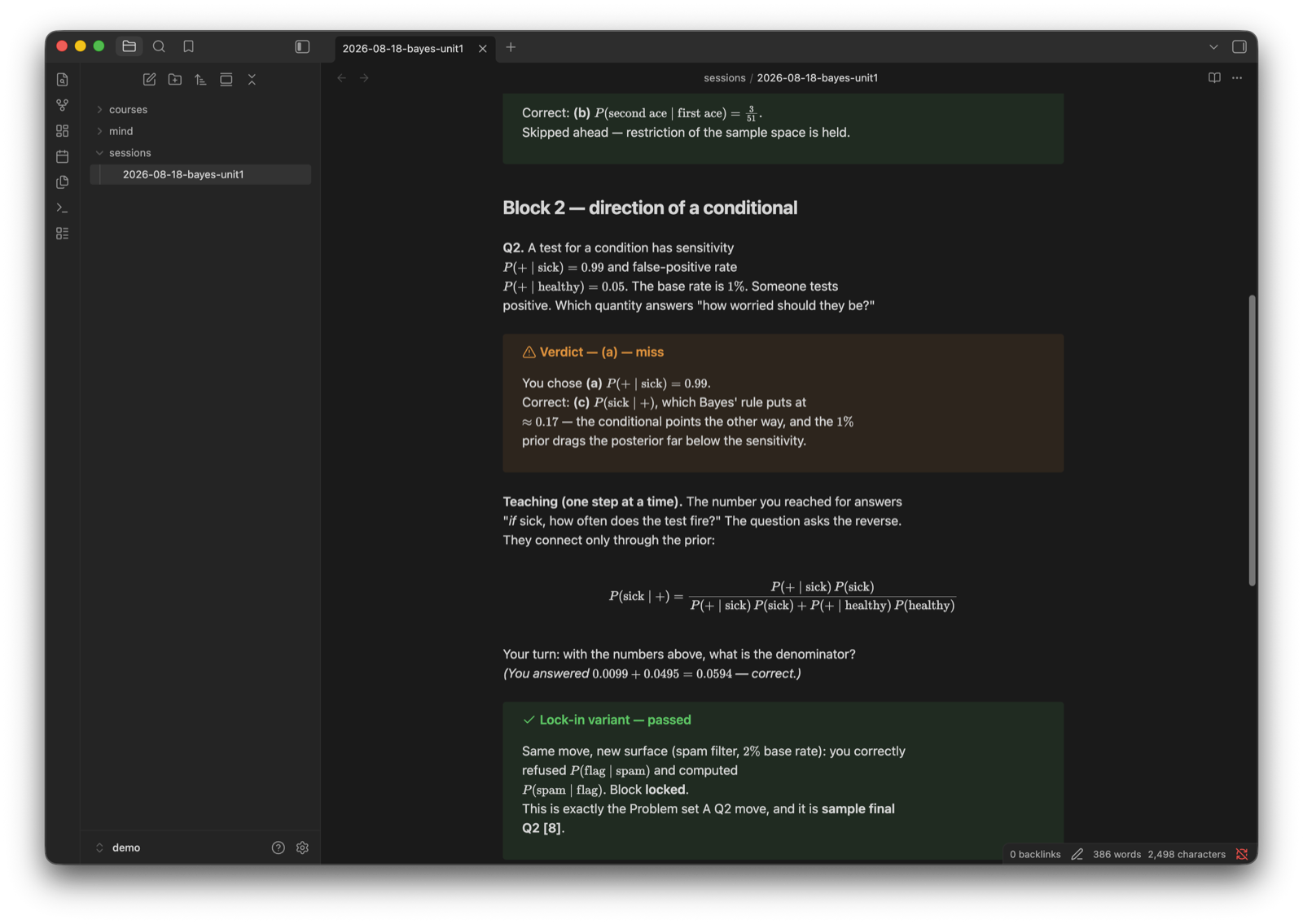
The open-source path: a live session in Obsidian, the reference renderer — the dependency graph with progress and ETA, a callout verdict, and a checkbox question waiting on a click.
Parents do not need any of this; Lambda Mind and the study lounge are the turnkey product. It is here because a learning tool you can inspect to the last line is one you can trust with your child.
Pointers
- lambda.fatfort.com — the study lounge.
- github.com/abaj8494/lambda-agent — the open protocol: skills, vault spec, worked demo.
- fat-fort — parent project (fatfort.com).
Backlinks (4)
1. How I passed the AWS Solutions Architect in 2 weeks /blog/how_i_passed_the_aws_solutions_architect_in_2_weeks/
G’day, welcome to my corner of the internet. This blog post is an extension of my Reddit post, and contains tangential details of my experience preparing for and undertaking the SAA-C003 AWS Solutions Architect Exam in 2026.
2. How I passed the AWS Solutions Architect in 2 weeks /roam/how_i_passed_the_aws_solutions_architect_in_2_weeks/
G’day, welcome to my corner of the internet. This blog post contains more pointers to resource materials that I have used / advertise as software that I manage. Shilling aside, this site is a more multi-modal presentation of my 15 day journey.
Here is the PDF that I wrote notes in:
TODO: Embed PDF
Why 15 days?
I am currently a graduate student in Statistics and had a 2 week break between terms. I have an undergraduate in Computer Science with no work experience. I figured an AWS cert may help authenticate my System Design and AWS skills.
3. Solutions Architect: SAA-C003 /roam/solutions_architect_saa_c003/
I take this exam on the 11th of September 2026. I’ll update here as I pass / fail the exam.
As of 16 days out, I’ve purchased the TutorialDojo Practice Exam pack AND the Video Course.
λambda has injested the slides and is preparing me for the exam.
Update: 16 days later, I have passed this exam with an underwhelming score of 742/1000. I have written a blog post over at here, and then also intend to publish a post on Reddit which may or may not be linked here.
Comments