Polyrez
Polyrez is an all-in-one managed system for your resumes: one master file, branched into a tailored résumé (a Réz) for every profile, role and company you apply to, rendered live with Typst or LaTeX. Manage all your Rézi in one place, keep them under version control, and never let a tool write your words for you.
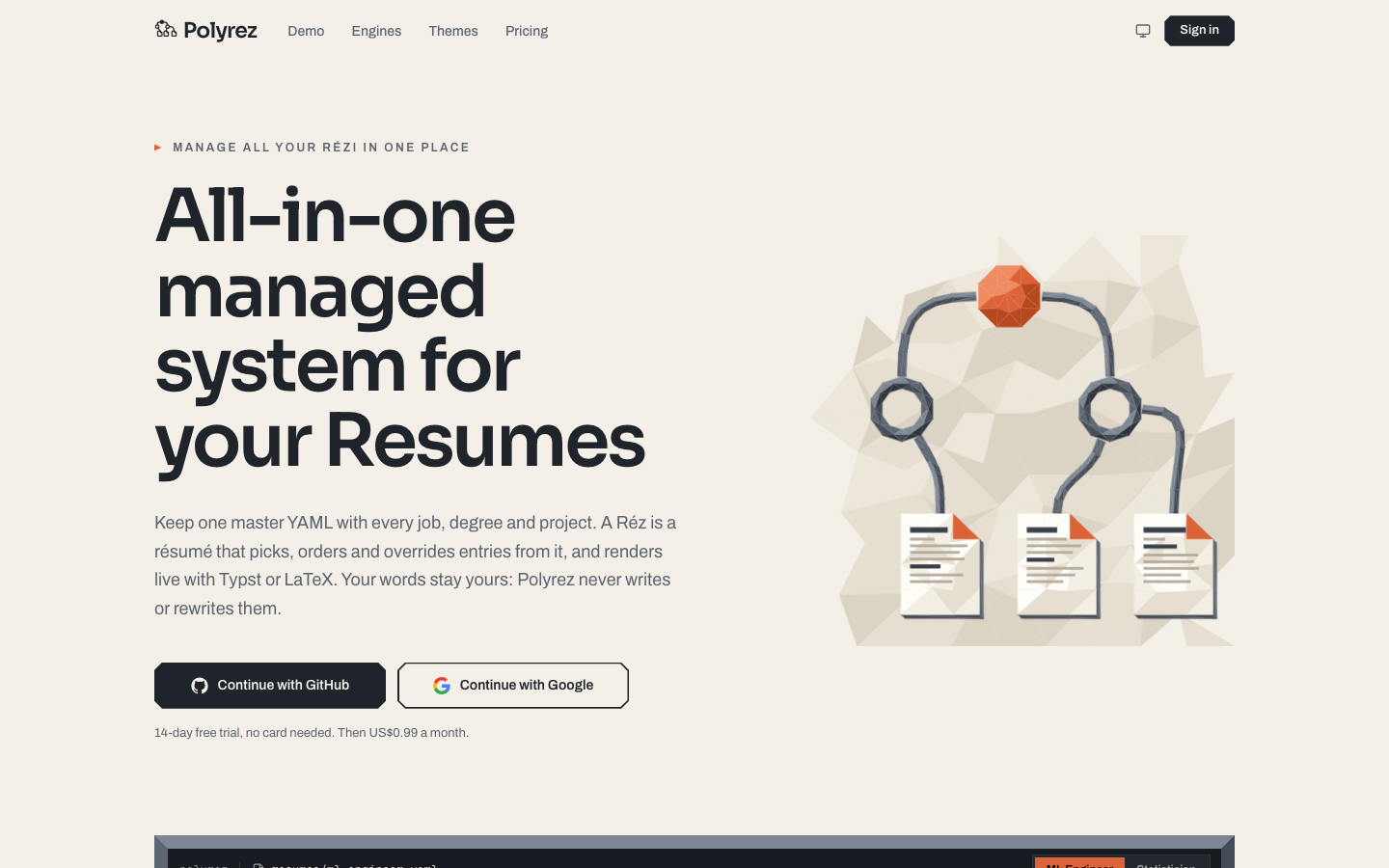
The landing page. One master YAML on the left, the rendered Réz on the right; the tree in the logo is the data model.
The idea
Most résumé builders hold one document per résumé, so tailoring for a second role means copying the first and letting the two drift. Polyrez inverts that. Every bullet point, project, degree and skill lives once in a master, and each Réz is a small file that says which of those atoms to include, in what order, and which fields to override for this reader.
- Master → Profile → Role → Company. A Technical profile hides nothing but sets the defaults; ML Engineer under it narrows; Canva under that changes one headline and two bullets. Edit the master and every Réz picks the change up, except where an override pins a field.
- Profiles are defaults, not limits. A General profile for retail applications hides
Projects by default, yet the Bunnings Réz can still include the one project that
matters there. Defaults are tag rules (
include_tags: [general, retail]), so a new atom with the right tag lands in the right places without editing anything. - Atoms have history. Every save snapshots each changed entry. Click a heading in the outline and you get a timeline with word-level diffs, side-by-side compare, the list of Rézi that include the atom, and one-click “use this version here”.
What it does
- Two engines. Typst by default (seven themes, including a faithful port of the McDowell résumé class, Harvard, Ink and Ember) and LaTeX with real classes: AltaCV, moderncv, a Jake’s-style template and mcdowellcv. Download the PDF, a PDF/A-2b, PNGs, Markdown, HTML, or the full source as a zip ready for Overleaf.
- Force one page. Instead of a manual margin fight, a bounded search over margins, type size, leading and spacing finds the gentlest compression that fits, and says so honestly when it cannot.
- An Overleaf-style editor with a YAML pane and a form view over the same file,
an outline with checkboxes and right-click menus, undo, Vim and Emacs bindings
(
:set wrapworks), a live PDF preview with clickable links, dark mode, and personal thumbnails everywhere. - Version-control friendly. Connect a GitHub repository you own and every save becomes a commit of the YAML and the PDF; edits made on GitHub flow back.
- Share links. A permanent, unlisted, revocable page per Réz that shows only the PDF, with a proper preview when pasted into chat.
- Open formats. Import rendercv YAML or JSON Resume; export back to rendercv. Your data is a folder of plain text you can download in one zip at any time.
- No text generation. Polyrez writes code, never your Réz. There is no AI in the editing loop; every word on the page is one you typed.
Pricing
One plan, three ways to pay: US$0.99 a month, US$10 a year, or US$100 once for the Believer tier, which is Pro forever. Fourteen days free without a card; after that an unpaid account can still view and download what it made.
Under it
Next.js and Postgres in a single container behind Caddy and Cloudflare, Typst in the same image, and TeX Live in a sandboxed sibling container with no network and no shell escape. Rendering is content-addressed and cached, so identical inputs never compile twice. Hosted on a small VPS in Sydney; no analytics, no third-party scripts.
Pointers
- polyrez.app — the app.
- fat-fort — the parent company (fatfort.com).
- Arcade Express and TutorsFirst — sibling products.
- abaj.ai — main site, writing, and past work.
Comments