sudoku is the drosophila of constraint satisfaction: small enough to hold in your head, rich enough to demonstrate every solving paradigm that matters. this page works through four of them against my actual code — a backtracking solver with \(O(1)\) constraint sets (arcade/references/sudoku/solver.py), a dart port that also generates puzzles (arcade-mobile), an integer-programming formulation solved for real with scipy, and the exact-cover view that leads to knuth’s algorithm x. every timing below is a real run on this machine.
Agentic
a linearly separable dataset admits infinitely many separating hyperplanes, and the perceptron will happily hand you whichever one it trips over first. 𐃏 the support vector machine asks a better question: of all the hyperplanes that separate the data, which one is farthest from everybody? the answer — the maximum-margin hyperplane — is determined by a handful of boundary points (the support vectors), drops out of a beautiful convex dual, and generalises via the kernel trick from lines to nearly anything.
This page is for the richness of Babel.
There are at least four Babels worth keeping in one place: a real tower, a story about the tower, a library built out of the story, and a piece of software I use every day. They are all the same idea wearing different clothes — the totality of language, and what it costs.
the tower that actually stood
Babel was a real place before it was a metaphor. The name is Bab-ilim — “gate of the god” — Babylon, on the Euphrates, and its tower was the Etemenanki: “the temple of the foundation of heaven and earth,” a seven-tiered ziggurat of baked brick and bitumen sacred to Marduk, rising perhaps 90 metres over the city. It was old when history found it — damaged and rebuilt across centuries, most famously restored by Nebuchadnezzar II (r. 605–562 BCE), who recorded the work in glazed-brick boast: its top was to “rival the heavens.”
there is exactly one theorem in machine learning that every practitioner rederives on a whiteboard at least once a year, and this is it. 𐃏 the squared-error risk of any learned predictor splits into three non-negative pieces — irreducible noise, squared bias, and variance — and every design decision you make (model class, regularisation strength, \(k\), ensemble size, early stopping) is secretly a transaction between the last two.
A printable guide to solving the Rubik's cube with the Roux method, after Gilles Roux: notation pinned down, every term defined, and all 42 CMLL and every last-six-edges case drawn. Also a 22-page PDF.
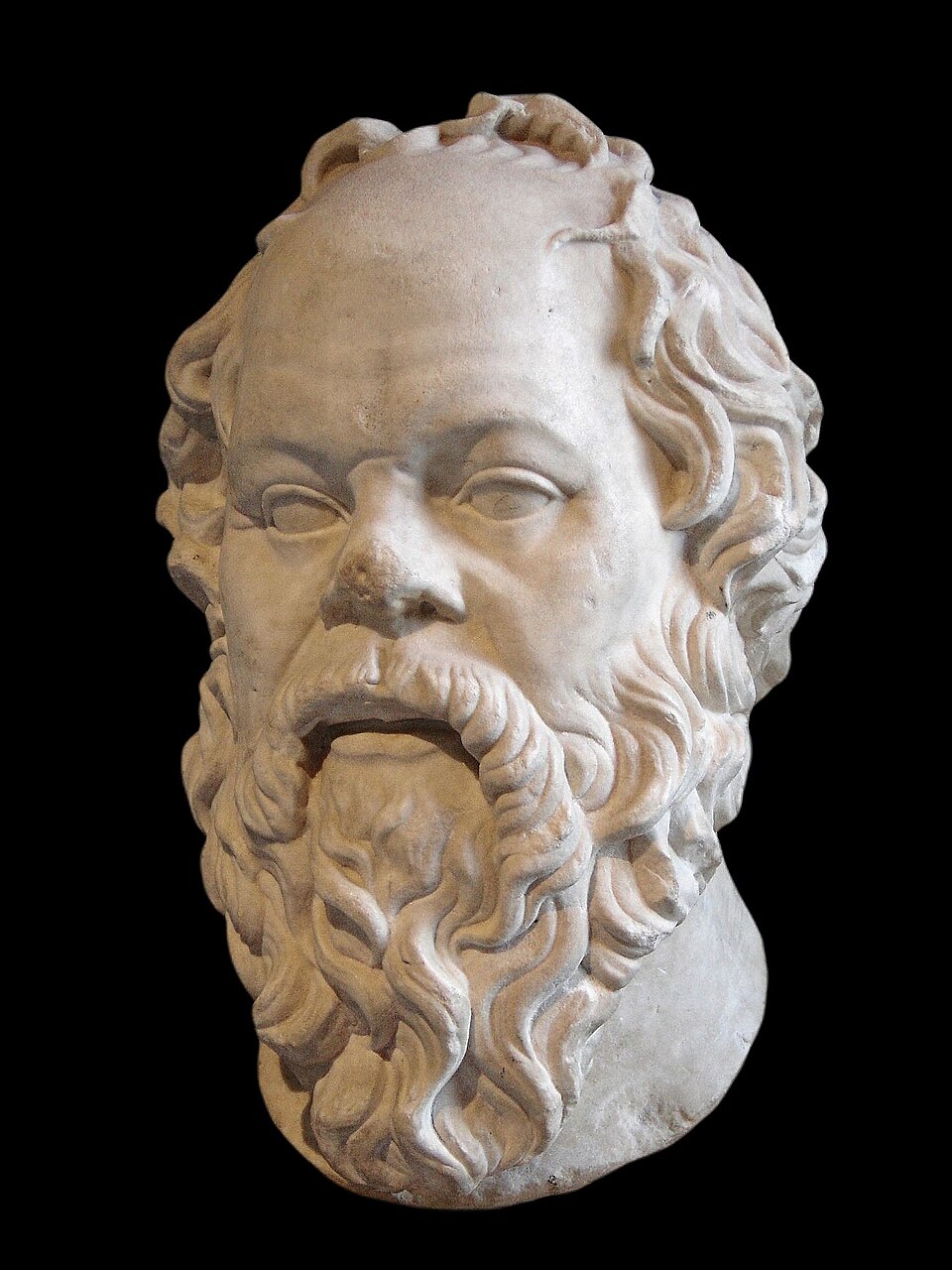
Socrates, Roman marble after a Greek bronze by Lysippos — the Louvre. He was, by every account including his own, remarkably ugly: snub nose, bulging eyes, the face of a satyr. Athens never forgave him for showing them that beauty was elsewhere.
before a transformer sees a single number, text must be cut into pieces and each piece mapped to an integer. the tokeniser is that cut — the least glamorous and most consequential preprocessing step in the whole pipeline, since it fixes the vocabulary, the sequence length, and what the model can represent at all. 𐃏
the transformer (Vaswani, Ashish and Shazeer, Noam and Parmar, Niki and Uszkoreit, Jakob and Jones, Llion and Gomez, Aidan N. and Kaiser, Lukasz and Polosukhin, Illia, 2017) deleted recurrence from sequence modelling and replaced it with a single primitive — attention — applied in parallel over the whole sequence. 𐃏 every token gets to look at every other token in one matrix multiply, the maximum path length between any two positions drops from \(O(n)\) to \(O(1)\), and training parallelises across the sequence dimension. this page derives the machinery; a from-scratch decoder-only build lives at nanogpt.
ordinary tic-tac-toe is a solved bore — both players draw with a lookup table. glue nine boards together and add one rule about where you are allowed to move, and suddenly the game tree is deep enough that you need actual search theory: minimax, the negamax reformulation, alpha-beta pruning, and a heuristic to stand in for the leaves you cannot reach. this page documents the agent my partner and i wrote for unsw comp3411 (assignment 3, “nine-board tic-tac-toe”), warts and all — and the warts are instructive. 𐃏
the vision transformer asks a blunt question: if attention replaced recurrence for text, can it replace convolution for images? the answer (dosovitskiy et al. 2020, an image is worth 16x16 words) is yes — chop the image into patches, treat each patch as a token, and feed the sequence to a standard transformer encoder with almost no vision-specific machinery. 𐃏