Bytelocker in C
I loved locking up folders as a kid on the Windows 7 computers using batch scripts I didn’t understand.
# Welcome to the bytelocker!
This is a small program written in C to help me consolidate by understanding of `FILE` streams, *bitwise operations* and *memory representations* of data.
## What does bytelocker do?
Bytelocker takes in 2 arguments, a file and a password. It then encrypts this file in place with an ECB cipher.
## Why is this useful?
Whilst you can use this binary from the command line to encrypt a standalone file, as is the case with many `C` programs, you will find this integrates nicely within larger workflows. See below.
### My usecase.
I spend my day in vim and vimwiki. And sometimes I need to document slightly sensitive information which I don't feel comfortable leaving in plaintext. As such, I have added a binding to my vimrc calling the bytelocker utility.
The code snippet looks like:
`nnoremap E :silent ! '/Users/aayushbajaj/Google Drive/2. - code/202. - c/202.6 - bytelocker/bytelocker' '%' '$bl_pass'<CR>:set noro<CR>`
here pressing capital E in normal mode will encrypt the file.
- `silent` suppresses output
- `!` is the execution of a shell command, which then runs the bytelocker executable from my google drive
- `%` is a vim macro for the current file
- and the password is retrieved from an environmental variable defined in `.zprofile`.
- the definition looks like `export bl_pass="passwordpassword"`
- **NOTE: the password must be 16 characters!!**
- **NOTE: if you choose to define the password in another file, make sure your viwrc sources the file**
- the line in .vimrc would look something like `so "~/.config/zsh/.zprofile"
### Demo

tl;dr this used to be a standalone repo.
demo
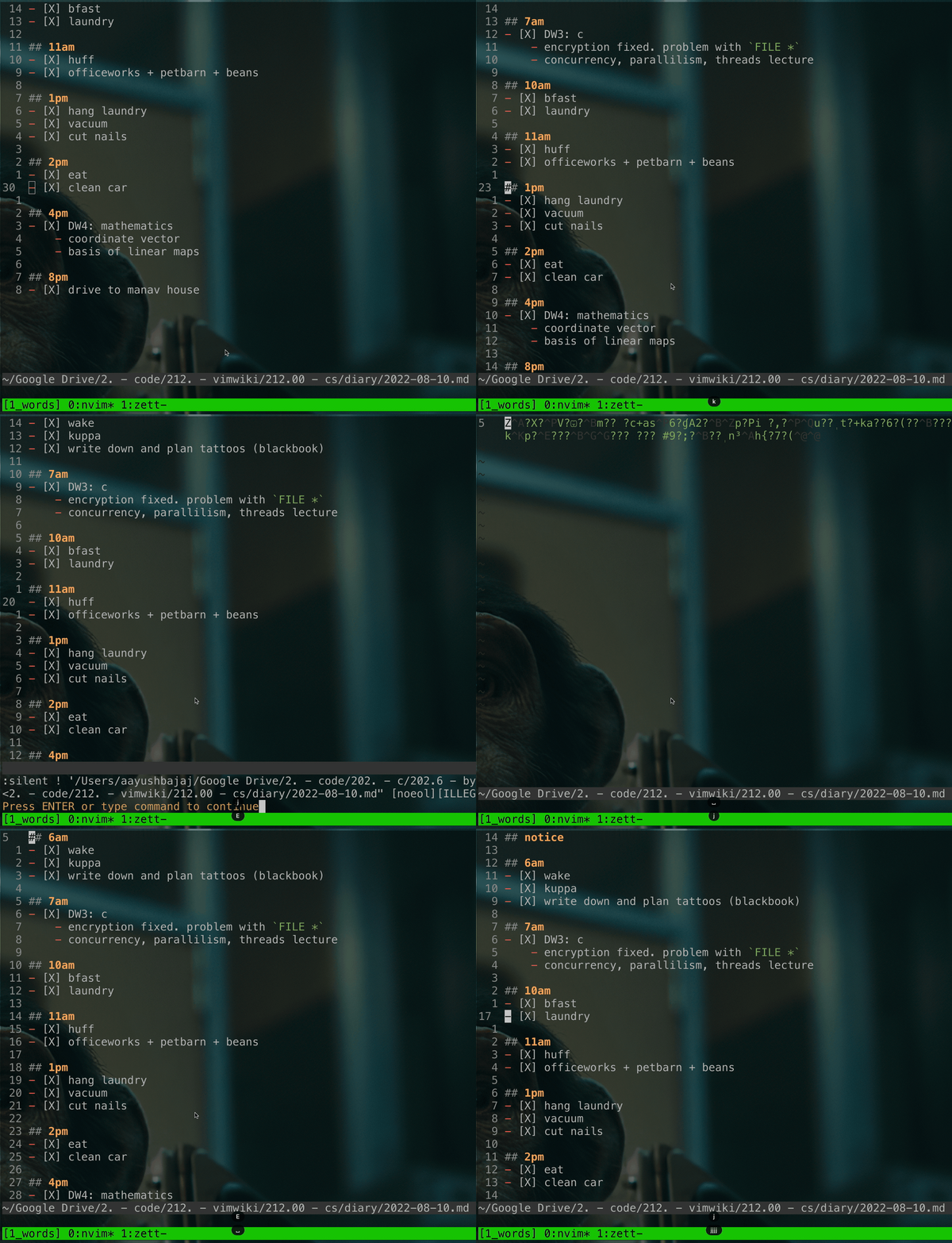
code
makefile
CC	= clang
CFLAGS	= -Wall

.PHONY:	all
all:	bytelocker

bytelocker:		bytelocker.c bytelocker.h main.c
        $(CC) $(CFLAGS) main.c bytelocker.c -o bytelocker

.PHONY: clean
clean:
        -rm -f bytelocker
bytelocker.h
#ifndef _BYTELOCKER_H
#define _BYTELOCKER_H

#include <stdbool.h>

#define MAX_PATH_LEN 4096
#define MAX_LINE_LEN 2048
#define RAND_STR_LEN 16
#define CIPHER_BLOCK_SIZE 16


bool test_perms(char filename[MAX_PATH_LEN]);
void encrypt_f(char *f, char *pass);
void decrypt_f(char *f, char *pass);
char *shift_encrypt(char *plaintext, char *password);
char *shift_decrypt(char *ciphertext, char *password);
char *rand_str(int seed);

#endif // _BYTELOCKER_H
bytelocker.c
#include <stdio.h>
#include <stdlib.h>
#include <stdbool.h>
#include <stdint.h>
#include <string.h>
#include <sys/stat.h>
#include <unistd.h>
#include <dirent.h>

#include "bytelocker.h"

const char *const MSG_ERROR_FILE_STAT  = "Could not stat file\n";
const char *const MSG_ERROR_DIRECTORY  =
    "bytelocker does not support encrypting directories.\n";
const char *const MSG_ERROR_READ       =
    "user does not have permission to read this file.\n";
const char *const MSG_ERROR_WRITE      =
    "user does not have permission to write here.\n";

void encrypt_f(char *f, char *pass) {
        char line[16];
        int r;
        FILE *f_r = fopen(f, "rb");
        FILE *tmp_w = fopen("tmp.txt", "wb");

        // writing a null character at start of file to indicate encrypted
        fwrite("\x00", 1, 1, tmp_w);

        // writing encrypted characters to tmp
        while ((r = fread(line, 1, sizeof line, f_r)) != 0) {
                if (r != 16) {
                        for (int i = r; i < 16; i++) {
                                line[i] = '\x00';
                        }
                }
                fwrite(shift_encrypt(line, pass), 1, 16, tmp_w);
        }
        fclose(tmp_w);
        fclose(f_r);

        // writing encrypted characters to original file
        FILE *f_w = fopen(f, "wb");
        FILE *tmp_r = fopen("tmp.txt", "rb");
        int c;
        while ((c = fgetc(tmp_r)) != EOF) fputc(c, f_w);
        fclose(f_w);
        fclose(tmp_r);
        remove("tmp.txt");
}

void decrypt_f(char *f, char *pass) {
        char line[16];
        int r;
        FILE *f_r = fopen(f, "rb");
        FILE *tmp_w = fopen("tmp.txt", "wb");

        // gobbling first null character
        fseek(f_r, 1, SEEK_SET);

        // writing decrypted characters to tmp
        while ((r = fread(line, 1, sizeof line, f_r)) != 0) {
                if (r != 16) {
                        for (int i = r; i < 16; i++) {
                                line[i] = '\x00';
                        }
                }
                fwrite(shift_decrypt(line, pass), 1, 16, tmp_w);
        }
        fclose(tmp_w);
        fclose(f_r);

        // writing decrypted characters to original file
        FILE *f_w = fopen(f, "wb");
        FILE *tmp_r = fopen("tmp.txt", "rb");
        int c;
        while ((c = fgetc(tmp_r)) != EOF && c != '\x00') fputc(c, f_w);
        fclose(f_w);
        fclose(tmp_r);
}


bool test_perms(char filename[MAX_PATH_LEN]) {
        // 4 cases:
        // - checks if file exists
        // - must be a regular file
        // - user must be able to read file
        // - user must have premissions to write

        struct stat s;
        // checking if a file exists
        if (stat(filename, &s) != 0) {
                printf(MSG_ERROR_FILE_STAT);
                return false;
        }
        // checking if file is a folder
        else if (s.st_mode & S_IFDIR) {
                printf(MSG_ERROR_DIRECTORY);
                return false;
        }
        // checking if user can read file
        else if (!(s.st_mode & S_IRUSR)) {
                printf(MSG_ERROR_READ);
                return false;
        }
        else if (!(s.st_mode & S_IWUSR)) {
                printf(MSG_ERROR_WRITE);
                return false;
        }
        else return true;
}


char *shift_encrypt(char *plaintext, char *password) {
        for (int i = 0; i < 16; i++) {
                uint8_t k = plaintext[i];
                for (int j = password[i]; j > 0; j--) {
                        k = k << 1 | k >> (8 - 1);
                }
                plaintext[i] = k;
        }
        return plaintext;
}

char *shift_decrypt(char *ciphertext, char *password) {
        for (int i = 0; i < 16; i++) {
                uint8_t k = ciphertext[i];
                for (int j = password[i]; j > 0; j--) {
                        k = k >> 1 | k << (8 - 1);
                }
                ciphertext[i] = k;
        }
        return ciphertext;
}

// and must be freed by the caller.
// generates random string of length 16
// same seed returns same string
// string composed of upper, lower and 0 - 9
char *rand_str(int seed) {
    if (seed != 0) {
        srand(seed);
    }

    char *alpha_num_str =
            "abcdefghijklmnopqrstuvwxyz"
            "ABCDEFGHIJKLMNOPQRSTUVWXYZ"
            "0123456789";

    char *random_str = malloc(RAND_STR_LEN);

    for (int i = 0; i < RAND_STR_LEN; i++) {
        random_str[i] = alpha_num_str[rand() % (strlen(alpha_num_str) - 1)];
    }

    return random_str;
}
main.c
#include <stdio.h>
#include <stdlib.h>

#include "bytelocker.h"

int main(int argc, char **argv) {
        // argv[1] = filename
        // argv[2] = password
        if (argc != 3) {
                fprintf(stderr, "Usage: %s <file to encrypt / decrypt> <password>\n", argv[0]);
                return EXIT_FAILURE;
        }
        if (!test_perms(argv[1])) {
                fprintf(stderr, "Do not have appropriate permissions on %s\n", argv[1]);
                return EXIT_FAILURE;
        }

        // checking first byte of file to see if it is ascii
        FILE *f = fopen(argv[1], "r");
        char check[1];
        fread(check, 1, sizeof(check), f);
        ungetc(check[0], f);
        fclose(f);

        // encrypts if ascii, otherwise decrypts
        if ( check[0] > 31 && check[0] < 127 ) {
                encrypt_f(argv[1], argv[2]);
        }
        else {
                decrypt_f(argv[1], argv[2]);
        }
}
Backlinks (2)
1. Wiki /wiki/
Knowledge is a paradox. The more one understand, the more one realises the vastness of his ignorance.