Gödel’s Incompleteness Theorem
In 1931 a twenty-five-year-old in Vienna published a paper proving that mathematics cannot fully formalise itself: any consistent formal system rich enough to do arithmetic contains true statements it cannot prove, and — worse — cannot even prove its own consistency (Gödel, Kurt, 1931). 𐃏 This page walks the actual argument: what the theorem says precisely, the two technical inventions that power it (Gödel numbering and diagonalisation), and — just as important — the long list of things it does not say.
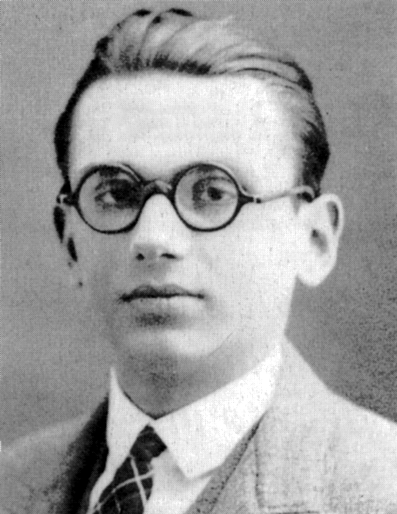
Kurt Gödel in 1925, as a student in Vienna — six years before the incompleteness paper. (Photograph in the public domain.)
The promise: Hilbert’s programme
By the 1920s the foundations of mathematics had survived two frights — the paradoxes of naive set theory (Russell’s barber-shaped hole in Frege) and the intuitionist revolt against non-constructive proof. David Hilbert’s response was an engineering project: formalise all of mathematics in one axiomatic system, then prove — using only “finitary”, uncontroversial reasoning — that the system is consistent (it never proves a contradiction) and complete (it settles every statement one way or the other). 𐃏 Proof itself would become an object of mathematical study, and mathematics would certify its own reliability by purely mechanical means.
Gödel’s two theorems close both doors. The first says no such system is complete; the second says the consistency proof Hilbert wanted is exactly the kind of statement the system cannot deliver about itself.
The setting: what counts as a “system”
The theorems are about formal theories: a language of first-order logic, a set of axioms, and the usual deduction rules. Three properties matter:
- Consistent: there is no formula \(\varphi\) with both \(T \vdash \varphi\) and \(T \vdash \lnot\varphi\). An inconsistent theory proves everything, so it measures nothing.
- (Negation-)complete: for every sentence \(\varphi\) in the language, \(T \vdash \varphi\) or \(T \vdash \lnot\varphi\). The theory leaves no question open.1
- Effectively axiomatisable: an algorithm can decide what is and is not an axiom. This is the “no cheating” clause — the set of all true sentences of arithmetic is a complete consistent theory, but there is no mechanical way to list it, so it is not a formal system in any useful sense.
The last ingredient is arithmetic strength: the theory must interpret enough of the arithmetic of \(\mathbb{N}\) — addition, multiplication, a little induction. Peano Arithmetic (PA) is the canonical example, but weak fragments (Robinson’s Q) already suffice, and anything stronger (ZFC, your favourite proof assistant’s kernel) is automatically in scope.
First incompleteness theorem. Let \(T\) be a consistent, effectively axiomatisable theory that interprets enough arithmetic. Then there is a sentence \(G_T\) in the language of \(T\) such that \(T \nvdash G_T\) and \(T \nvdash \lnot G_T\) — and \(G_T\) is true in the standard model \(\mathbb{N}\).
Note the shape of the trade-off: you may have consistency, effective axioms, arithmetic strength, or completeness — any three, never all four.
Arithmetisation: statements become numbers
The first invention is bureaucratic and the whole proof rests on it. Assign every symbol of the language a number — say \(\lnot \mapsto 1\), \(\forall \mapsto 2\), \(= \mapsto 3\), and so on — and encode a formula (a sequence of symbols) as a single number using prime factorisation:
\begin{equation} \ulcorner s_1 s_2 \cdots s_k \urcorner \;=\; 2^{c(s_1)} \cdot 3^{c(s_2)} \cdots p_k^{c(s_k)}, \end{equation}
where \(c(s_i)\) is the code of the \(i\)-th symbol and \(p_k\) is the \(k\)-th prime. Unique factorisation (number theory earning its keep) makes the coding reversible: from the number you can mechanically recover the formula. A proof — a finite sequence of formulas — gets coded the same way, one level up. 𐃏
Now the pivotal observation: syntactic properties of formulas become arithmetic properties of their code numbers. “\(n\) codes a well-formed formula”, “\(m\) codes a proof of the formula coded by \(n\)” — these are statements about numbers, checkable by primitive-recursive bookkeeping, and Gödel showed the checking is expressible by formulas of arithmetic itself. Define
\begin{equation} \mathrm{Prov}_T(n) \;:\equiv\; \exists m\; \mathrm{Prf}_T(m, n), \end{equation}
where \(\mathrm{Prf}_T(m,n)\) formalises “\(m\) codes a \(T\)-proof of the formula coded by \(n\)”. The loop has closed: arithmetic talks about numbers, numbers encode formulas, so arithmetic talks about formulas — including its own.
Diagonalisation: the sentence that talks about itself
The second invention manufactures self-reference without any hand-waving about “this sentence”. It is the same diagonal move Cantor used to show \(\mathbb{R}\) uncountable (sets), pointed at provability instead of decimal digits.
Diagonal lemma. For any formula \(\psi(x)\) with one free variable there is a sentence \(\sigma\) such that \(T \vdash \sigma \leftrightarrow \psi(\ulcorner\sigma\urcorner)\). \(\sigma\) “says” that \(\psi\) holds of \(\sigma\)’s own code.
The construction is short and feels like a card trick: consider the operation “substitute a formula’s own code into itself”, show it is computable hence arithmetically expressible, and apply it to itself. 𐃏
Now take \(\psi(x) := \lnot\mathrm{Prov}_T(x)\). The diagonal lemma hands us the Gödel sentence:
\begin{equation} T \vdash\; G_T \;\leftrightarrow\; \lnot\mathrm{Prov}_T(\ulcorner G_T \urcorner). \end{equation}
\(G_T\) asserts, via the coding, “\(G_T\) is not provable in \(T\)”. Note this is a perfectly concrete (if enormous) statement about natural numbers — the self-reference lives entirely in our interpretation of the codes.
The first theorem: the pincer
Suppose \(T \vdash G_T\). Then there is an actual proof, so \(\mathrm{Prf}_T(m, \ulcorner G_T\urcorner)\) holds for some concrete \(m\), and \(T\) — which can verify finite computations — proves \(\mathrm{Prov}_T(\ulcorner G_T\urcorner)\). But \(T \vdash G_T\) with the fixed-point equivalence also gives \(T \vdash \lnot\mathrm{Prov}_T(\ulcorner G_T\urcorner)\). Contradiction: \(T\) is inconsistent. So if \(T\) is consistent, \(T \nvdash G_T\).
Suppose instead \(T \vdash \lnot G_T\), i.e. \(T \vdash \mathrm{Prov}_T(\ulcorner G_T\urcorner)\). By the previous paragraph no proof of \(G_T\) exists, so for every concrete \(m\) the theory proves \(\lnot\mathrm{Prf}_T(m, \ulcorner G_T\urcorner)\) — yet it also proves \(\exists m\,\mathrm{Prf}_T(m, \ulcorner G_T\urcorner)\). The theory affirms an existential while refuting every instance. Gödel’s original argument outlaws this by assuming \(\omega\)-consistency; Rosser’s 1936 refinement replaces the Gödel sentence with a cleverer one (“for every proof of me there is a shorter proof of my negation”) and needs only plain consistency.2
And now the sting in the tail: since \(T \nvdash G_T\), no number actually codes a proof of \(G_T\) — which is precisely what \(G_T\) asserts: the Gödel sentence is true. 𐃏 Truth in \(\mathbb{N}\) and provability in \(T\) come apart, permanently: adding \(G_T\) as a new axiom just produces a stronger theory \(T^{\prime}\) with its own Gödel sentence \(G_{T^{\prime}}\). The hole moves; it never closes.
The second theorem: consistency is the price
The second theorem is the first one, proved inside the system. Look at what we established: “if \(T\) is consistent then \(T \nvdash G_T\)”. Write \(\mathrm{Con}(T)\) for the arithmetised consistency statement \(\lnot\mathrm{Prov}_T(\ulcorner 0 = 1 \urcorner)\). The entire pincer argument uses only reasoning that \(T\) itself can carry out — provided \(\mathrm{Prov}_T\) satisfies the three Hilbert–Bernays–Löb derivability conditions:
- If \(T \vdash \varphi\) then \(T \vdash \mathrm{Prov}_T(\ulcorner\varphi\urcorner)\) — the theory notices its own proofs;
- \(T \vdash \mathrm{Prov}_T(\ulcorner\varphi \to \psi\urcorner) \to (\mathrm{Prov}_T(\ulcorner\varphi\urcorner) \to \mathrm{Prov}_T(\ulcorner\psi\urcorner))\) — provability respects modus ponens;
- \(T \vdash \mathrm{Prov}_T(\ulcorner\varphi\urcorner) \to \mathrm{Prov}_T(\ulcorner\mathrm{Prov}_T(\ulcorner\varphi\urcorner)\urcorner)\) — condition 1, internalised.
Formalising the pincer yields \(T \vdash \mathrm{Con}(T) \to G_T\). So if \(T\) proved its own consistency it would prove \(G_T\) — which the first theorem forbids:
Second incompleteness theorem. If \(T\) is consistent (effectively axiomatisable, arithmetically strong), then \(T \nvdash \mathrm{Con}(T)\).
This is the theorem that ends Hilbert’s programme on its own terms: any “finitary” consistency proof for PA would live inside PA (finitary reasoning being the weakest thing around), and PA cannot host it. Consistency certificates must always be purchased from a stronger theory — whose consistency is in turn on credit. 𐃏
What it does not say
No theorem attracts misuse like this one, so the fine print deserves its own section.
It does not say every system is incomplete. Drop any hypothesis and completeness is back on the menu:
Theory Complete? Decidable? Why it escapes Presburger arithmetic (\(\mathbb{N}\), +) yes yes No multiplication — too weak to code proofs Real closed fields (Tarski) yes yes No way to define \(\mathbb{N}\) inside \(\mathbb{R}\) True arithmetic \(\mathrm{Th}(\mathbb{N})\) yes no Not effectively axiomatisable PA, ZFC, … no no All hypotheses hold It does not conflict with Gödel’s own completeness theorem (1929). That result says first-order logic proves every semantically valid consequence; incompleteness says no effective axiom set captures all truths of the one intended model \(\mathbb{N}\). The logic page keeps the two apart.
It does not say the Gödel sentence is interesting mathematics. \(G_{\mathrm{PA}}\) is a contrived numerical statement. But natural examples followed: Goodstein’s theorem and the Paris–Harrington principle are ordinary-looking combinatorial truths unprovable in PA.
It does not license “therefore minds beat machines” or “therefore nothing is certain”. The Lucas–Penrose argument needs the premise that we can know our own reasoning to be consistent — exactly what the second theorem makes suspect for any formal system, human-implemented or otherwise (Nagel, Ernest and Newman, James R., 2001).
Aftermath
Five years later Turing recast the whole story computationally: the halting problem is undecidable, and incompleteness falls out as a corollary — a complete effective theory of arithmetic would let you decide halting by searching for proofs (Hodges, Andrew, 1983). The two results are one phenomenon in different costumes: diagonalisation against provability, diagonalisation against computability. 𐃏 Provability itself became a subject — the modal logic GL axiomatises exactly what \(\mathrm{Prov}_T\) can say about itself — and proof assistants live comfortably with the limitation: they verify mathematics daily while cheerfully declining to certify their own kernels.
The theorem’s popular reputation is as a wrecking ball, but inside mathematics it functions as a map: it marks where the boundary of each formal system lies, and guarantees the hierarchy of theories above PA — each proving the consistency of the ones below — never flattens into a final system. Mathematics did not collapse in 1931; it acquired a horizon.
See also
- logic — first-order logic, soundness, and the 1929 completeness theorem this page keeps being confused with
- sets, functions and sequences — Cantor’s diagonal argument, the ancestor of the diagonal lemma
- number theory — unique factorisation, the substrate of Gödel numbering
- classical algorithms — computability, the halting problem’s home turf
References
Gödel, Kurt (1931). Über formal unentscheidbare Sätze der Principia Mathematica und verwandter Systeme I, Monatshefte für Mathematik und Physik.
Hodges, Andrew (1983). Alan Turing: The Enigma, Simon and Schuster.
Nagel, Ernest and Newman, James R. (2001). Gödel’s Proof, New York University Press.
“Complete” is the most overloaded word in logic: negation-completeness of a theory (at issue here), semantic completeness of a proof calculus (Gödel 1929), refutation-completeness of resolution, NP-completeness of a problem. Four different concepts on one syllable. ↩︎
A theory is \(\omega\)-inconsistent if it proves \(\exists x\,\varphi(x)\) while also proving \(\lnot\varphi(\bar{n})\) for every numeral \(\bar{n}\). Such a theory can be consistent — it just has no model whose “numbers” are only the standard ones. Rosser’s trick makes the whole argument immune to this subtlety, which is why modern statements of the theorem require only consistency. ↩︎
Backlinks (2)
1. Logic /wiki/mathematics/discrete/logic/
logic is the study of valid inference: which conclusions are forced by which premises, independent of what the premises are about. 𐃏 it splits cleanly into a syntax (formulas, and rules for pushing them around) and a semantics (truth assignments, models), and the deepest theorems in the subject are exactly the ones that say when the two agree (Epp, Susanna S., 2019).
2. Discrete Mathematics /wiki/mathematics/discrete/
discrete mathematics is the mathematics of structures that come in separate, countable pieces — integers, truth values, finite sets, graphs — as opposed to the smooth continuum of analysis. 𐃏 no limits, no derivatives; instead: induction, counting, and exact structure. it is the native mathematics of computation — every data structure, algorithm, database query and cryptographic protocol below this page is discrete mathematics wearing a lab coat (Epp, Susanna S., 2019).
Comments