| # | Course Code | Title | Offered | Prerequisites | Term | Type | Textbook | Notes |
| 1. | COMP6713 | Natural Language Processing | T1 | MATH1081,9444 | 26T1 | Elective | na | |
| 2. | FINS5513 | Investments and Portfolio Selection | T1,2,3 | 8750 program | 26T1 | Elective | na | |
| 3. | FINS5536 | Fixed Income Securities and Interest Rate Derivatives | T2 | 5513 | 26T2 | Elective | na | pricing, hedging, risk management. options, futures and swaps (int rate derivs) |
| 4. | MATH5856 | Introduction to Statistics and Statistical Computations | T2 | 26T2 | Elective | na | recommended for 5905 | |
| 6. | MATH5960 | Bayesian Inference and Computation | T3 | 2801/2901 | 26T3 | Elective | ||
| 7. | MATH5825 | Measure, Integration and Probability | T3 | U5705 | 26T3 | Elective | na | implicit prereq for 5835 |
| 8. | MATH5905 | Statistical Inference | T1,2,3 | U5846,U5856 | 27T1 | Core | na | |
| 9. | COMP9518 | Advanced Machine Learning | T2 | 9517 | 27T2 | Elective | na | |
| 10. | MATH5845 | Time Series | T2 | 27T2 | Elective | na | ||
| 11. | MATH5855 | Multivariate Analysis | T3 | 27T3 | Elective | na | ||
| 12. | MATH5835 | Advanced Stochastic Processes | T1 | U5825 | 28T1 | Core | na | Difficult. Requires an understanding of Real Analysis and Measure Theory |
| 13. | MATH5806 | Applied Regression Analysis | T2 | 28T2 | Elective | na | splines, poisson / binomial regression | |
| 14. | MATH5925 | Project (12uoc) | T1,2,3 | 36UoC | 28T2 | Core | na |
the rabbit hole:
Tribute
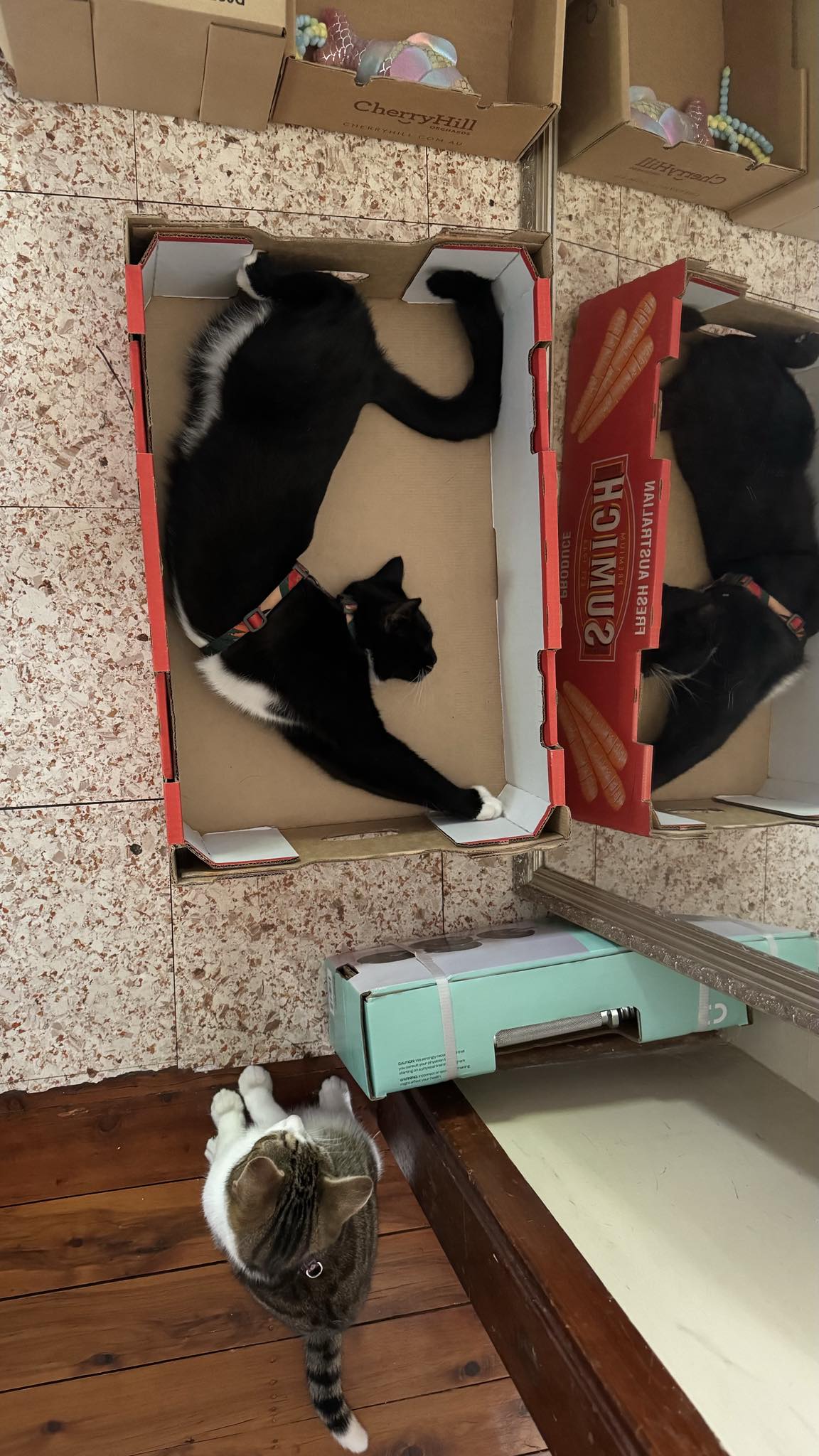
My beautiful, sweet sweet Mia.
Papa's sorry that you're gone, so is Phillip, and especially is Mama.
We were all shocked and saddened deeply. We grieved and still do.
You made it into Papa's arm, and Mama's leg, we got ink.
I see you every-time I brush my teeth.
Recount
- Mia was born at my parent's house.
- She had 4 litter-mates.
- She stayed, the others didn't.
- Her mother died to traffic weeks later
- Mia was a cat raised with love from birth.
- She moved out at 1 and then again 6 months in. Her life became more fun, stimulating and interesting.
- She lived outdoors her whole life, ate roast beef from Aldi and ate salmon from Costco.
- She was attacked twice, and turned from the sweetest cat to the "sweetest around family cat"
- She way loyal and supervised much debauchery along with even more destiny-seeking.
- She stopped hissing at Phillip eventually, and they even grew together as best-friends for 6-months.
- Mia was killed1 by a slow moving vehicle.
Pre-mortem prose:
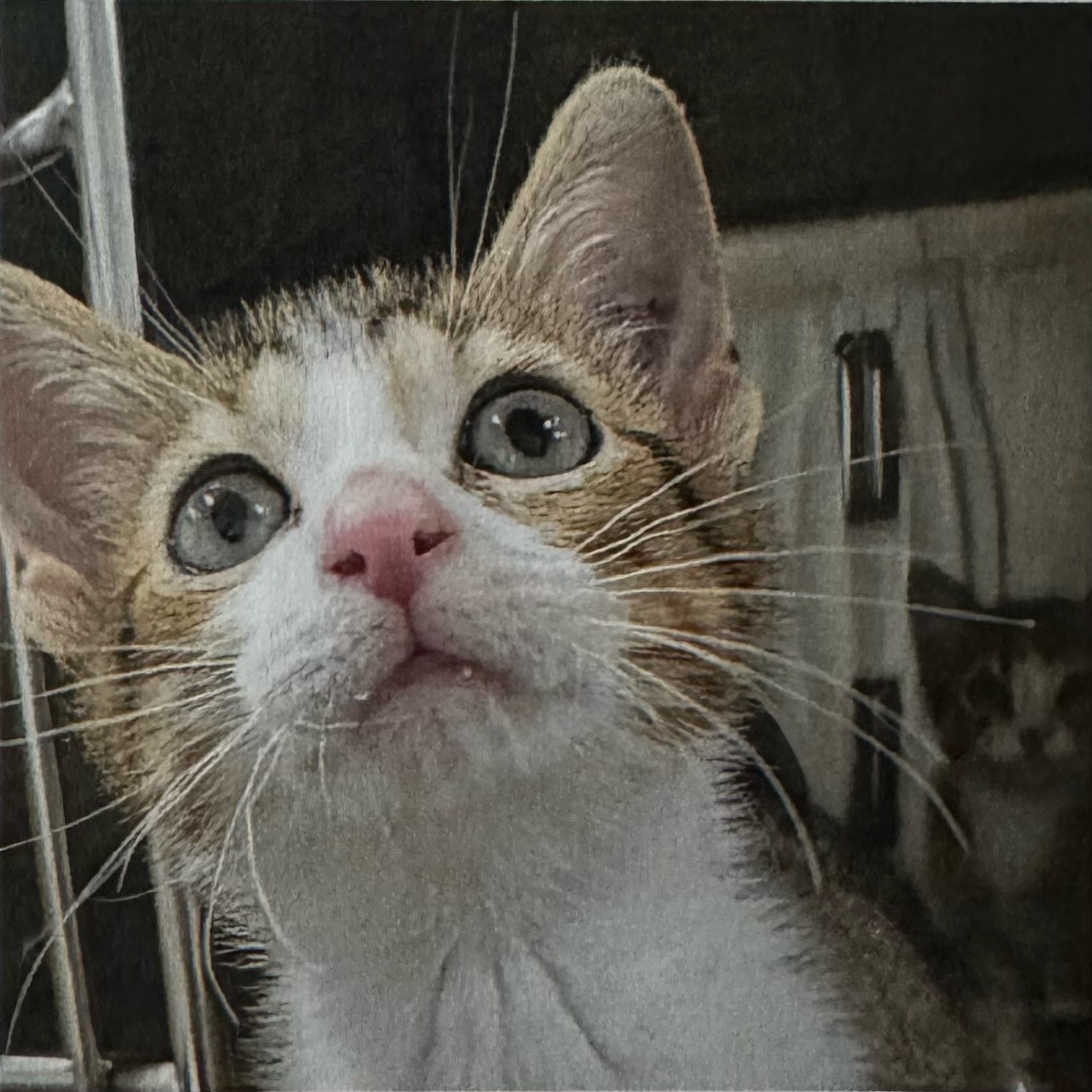
Mia is a good cat. Very tame. She's been following me around since she was a blue-eyed baby:
I ran barefoot for upwards of a year. Here are my thoughts on the
Verdict
I do not recommend it. Especially in the city where it is likely that your running surface will be concrete or pavement.
It is terrible for your feet, and worse for your knees. It is dangerous and it is painful, please do not do it.
TODO: insert toes, perhaps a spoiler?
Disclaimer aside, I shall proceed to justify and describe my experience clocking about 150km(?) barefoot.
Summary
\[\Huge \sum_{k=1}^{\infty} \frac{1}{k^2} = \frac{\pi^2}{6} \]
Here lies the Sanskrit word Mudita.
The word is defined as sympathetic joy, an antithesis to the words envy and jealousy.
It emerges from the Pāli Canon which religiously and philosophically lie beside the Buddhist teachings.
It is one of the Four Brahmavihārās:
- Mettā – loving-kindness
- Karunā – compassion
- Mudita – sympathetic joy
- Upekkhā – equanimity
Noto Sans Devanagari
Siddhanta
Kohinoor Devanagari
Sarasvati
Lohit Devanagari
Chandas
This page is for the richness of Babel.
I shall come back to populate it with Biblical history, Emacs inspirations and unpack Jorge's concept of infinity in this blog post.
The human mind is a fickle creature. It is prone to dozens of cognitive biases, and the way it is strengthened, is paradoxical:
To learn, you must forget
The above is a mantra all my students are familiar with, and derives from an understanding of Ebbinghaus' forgetting curve.
Additionally, the human-mind is highly fragile:
- vulnerable to brain damage (dementia)
- psychological impairments
And biologically expensive:
- contributes a meagre 2% of the human mass
- is responsible for 20% of the body's energy consumption.
Whilst this sword is double-edged; it enables our creativity, capacity for complex thought, reasoning, etc.; the design of this organ leads to largely improper use by its hosts.
This is Phillip, a.k.a Lord Phillip, Prince Phillip.
Phillip was a Petbarn rescue. We got him at the age of 2 months and 19 days.
He likes to climb trees and nibble on fingers. He drinks lots of water and pants whilst playing. He is more of a dog than a cat.
Phillip enjoys eating egg, butter, cheese and yoghurt. Any diary really. He also like Hashbrowns.
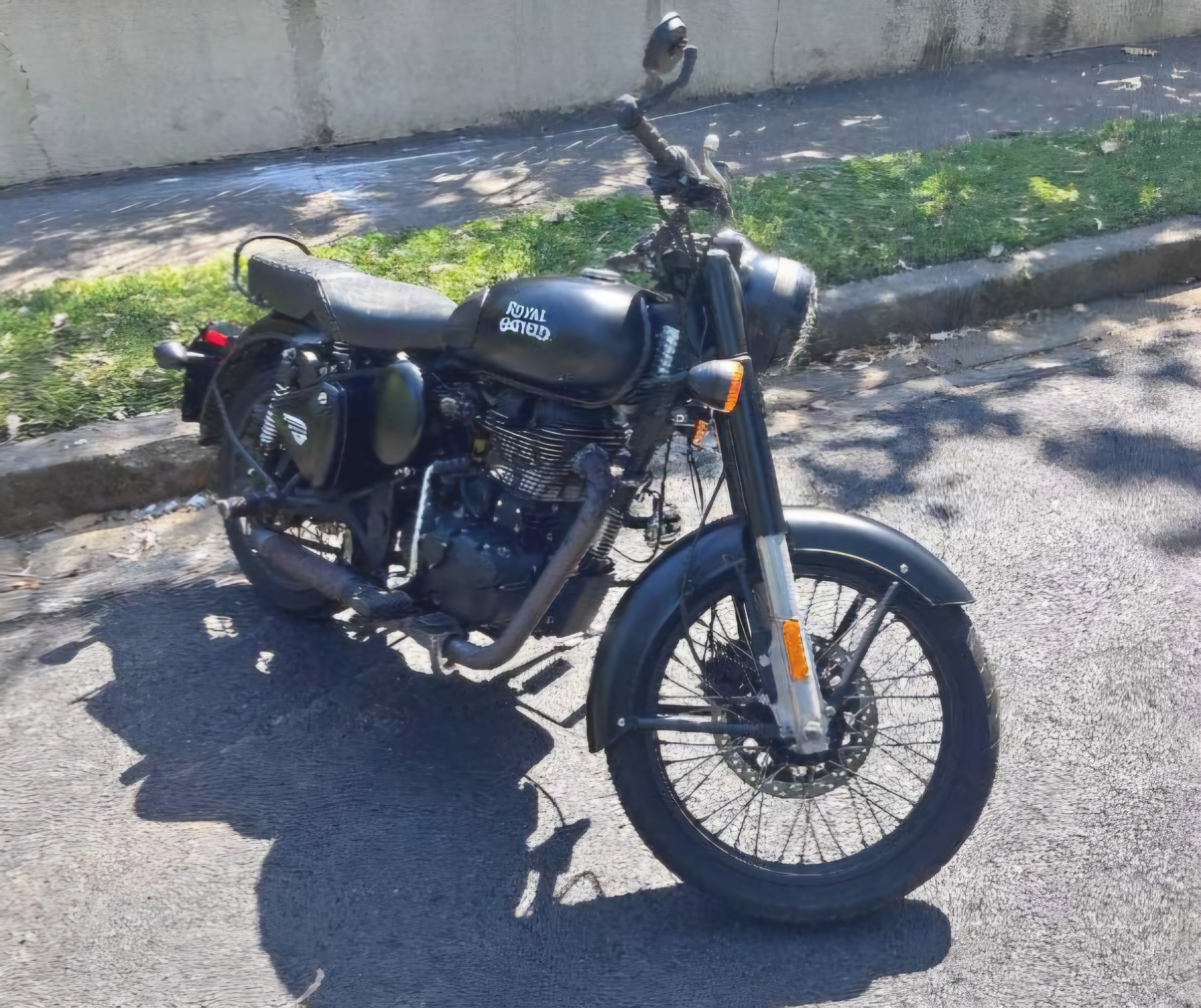
This is my first bike, I bought it second hand:
I got it because it fit my needs:
- comfortable 2 seater
- royal enfield
- affordable
I paid 5.5k AUD for it, and recently had to spend another 2k because the previous owner had let it rust from the rain of the Northern Beaches.
I had also tried to do some work on it and ended up snapping the bolt securing the oil filter cap on the underside of the engine.
These days I work in Emacs, but before then I lived in Vim/Tmux for 2 years. My youth though was never this technical nor was it officially programmatic.
I instead spent my time hacking, tinkering and breaking things.
I spent my time in primary school creating hidden folders1 on my student drive to hide games from my teachers. But even earlier than that, I had a penchant for doing the wrong thing.
I was first introduced to this concept by Distrotube (Derek Taylor's) "literate config" files. At the time I was not using emacs and thus all the code I was writing was sparingly commented.
Since then, I have entered a world of Machine Learning and Deep Learning, where suddenly in 4 lines, I can sit atop my high-horse and perform sentiment analysis with tensorflow and keras!
from transformers import pipeline
classifier = pipeline('sentiment-analysis')
prediction = classifier("Donald Knuth was the greatest computer scientist.")[0]
print(prediction)
Device set to use mps:0
{'label': 'POSITIVE', 'score': 0.9997720122337341}
In such an age of abstraction complexity, it becomes paramount to distill what is happening at the last few \((n-k)\) layers.
This blog post has been created to convince you that real-world probability, is in fact Bayesian probability.
Anyone who believes that a frequentist approach is superior may be correct (for that particular example), but it must be said that the Bayesian framework is a superset of this naive and trivial card-playing model of probability.
We are no longer trying to determine the probability of landing a `double-six` dice roll, and rather we are trying to figure out what the probability is that Mia (our cat) will be waiting for us on the porch when we get home.